Your Shopify store may already be feeling this shift.
Ads that used to find the right buyers now feel less predictable. Retargeting windows are less dependable. Platform reporting rarely tells a clean story, and every new privacy change seems to reduce the amount of customer insight you can passively collect. For many store owners, that creates a bad cycle: less signal, weaker targeting, more wasted spend, and more pressure to discount.
The fix isn't finding a clever new tracking workaround. It's building a data strategy around direct customer relationships. That means asking customers what they want, when it makes sense to ask, and then using those answers to improve what they see next.
That's where 0 party data becomes useful. Not as a buzzword, but as a practical operating model for Shopify brands that want better segmentation, better product recommendations, and less dependence on cookies. If you're also thinking through the broader privacy side of this shift, Prometheus Agency on AI enablement and privacy is a worthwhile read because it frames the larger issue clearly: data strategy now has to work with trust, not around it.
Table of Contents
- The End of an Era and the Dawn of a New Data Strategy
- What Is Zero-Party Data Really
- Zero-Party vs First-Party Data and Other Types
- The Business Case for Collecting Zero-Party Data
- How to Collect Zero-Party Data on Shopify
- Your 4-Step Zero-Party Data Implementation Plan
- Measuring Success and Activating Your New Data
The End of an Era and the Dawn of a New Data Strategy
A lot of Shopify brands built growth around rented attention and passive tracking. That worked when ad platforms could stitch together more behavioral signal and retargeting felt almost automatic. It works less well now.
The store owner usually sees the symptoms before they name the cause. Meta performance swings harder. Returning visitor journeys are harder to interpret. Product pages get traffic, but merchandising decisions still rely on guesswork. You know people are interested. You don't know enough about what they want.
That problem creates an opening. Instead of trying to infer everything from clicks, you can ask better questions and collect answers with consent. For a Shopify merchant, that's a much more durable asset than another targeting trick.
Practical rule: If a customer preference would change what product you recommend, what email you send, or what offer you suppress, it's worth asking for directly.
A direct data strategy shifts your store from observation to conversation. You stop depending so heavily on signals from browsers and ad platforms, and you start building a customer profile around declared needs, preferences, and intent. That's more useful for merchandising, email, SMS, and post-purchase experience because the customer has told you what matters.
For stores with broad catalogs, this is often the fastest path to relevance. A fashion brand can ask about fit and style. A supplement brand can ask about goals and routine. A pet food brand can ask about breed, age, and sensitivities. Every one of those answers can improve the next step in the journey.
What Is Zero-Party Data Really
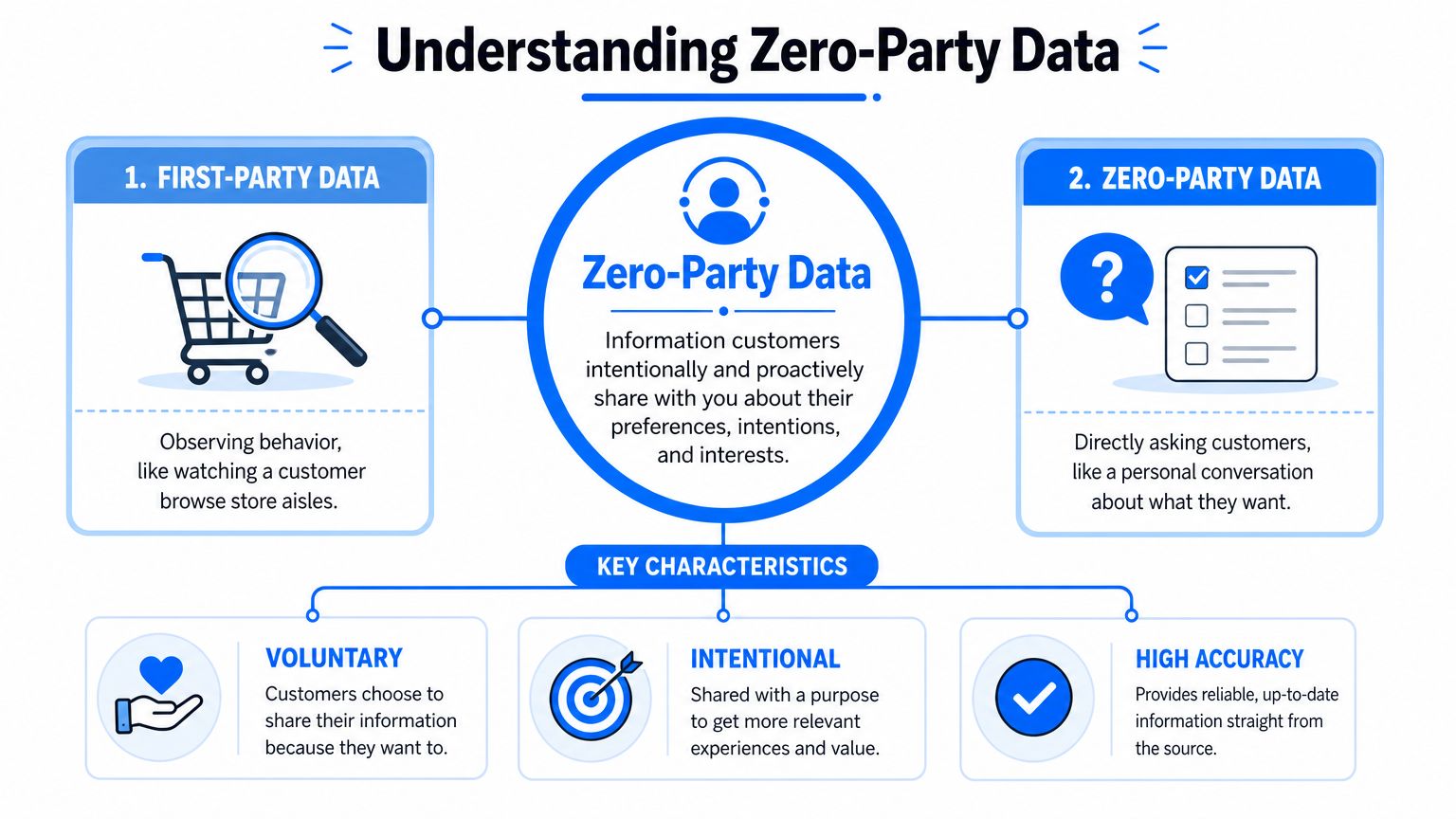
Zero-party data is information the customer gives you on purpose. The term was first coined and popularized by Forrester Research, which defined it as information a customer intentionally and proactively shares with a brand, as summarized by Zuora's explanation of zero-, first-, second-, and third-party data.
That definition matters because it separates this from the usual forms of tracking. You're not watching behavior and making your best guess. You're asking, and the customer is answering.
A simple analogy helps. First-party data is like watching someone browse the aisles of a store. You can see what they looked at, where they paused, and what they bought. Zero-party data is the conversation that happens when they tell you, "I'm shopping for a gift," or "I only want citrus scents," or "I need something for a sensitive dog."
If you run Shopify, this isn't abstract. It changes how you structure your forms, your lead capture, and your product discovery flows. A useful companion read is how zero-party data helps Shopify brands, especially if you're evaluating the shift from passive collection to direct preference capture.
Why the definition matters in practice
The phrase "intentionally and proactively shared" puts a higher bar on what counts as 0 party data. A purchase history isn't zero-party data. Page views aren't zero-party data. Even email opens aren't zero-party data.
What does count is information like:
- Preference inputs such as favorite product categories, ingredient preferences, or communication frequency
- Purchase intentions such as shopping for self versus gift, budget range, or timing
- Personal context such as skin concerns, pet age, sizing preferences, or use case
- Recognition preferences such as how often they want to hear from you or what type of messages they want
That last category gets overlooked, but it's often the easiest place to start because it improves email and SMS relevance quickly.
What counts as zero-party data on a Shopify store
On a Shopify store, 0 party data is usually collected through interactive formats rather than static account fields. The common collection points are surveys, quizzes, preference centers, registration flows, and post-purchase forms.
What makes these useful isn't just that the customer answers. It's that the answer can immediately change something downstream. A skincare quiz can route to a product bundle. A signup form can tag a contact by category interest. A post-purchase survey can help you separate replenishment shoppers from gift buyers.
Ask for information that can trigger action. If an answer won't change the experience, don't put friction in front of the customer to collect it.
Zero-Party vs First-Party Data and Other Types
The biggest confusion in this topic is the difference between zero-party and first-party data. For Shopify merchants, that distinction isn't academic. It changes how you personalize.
According to Salesforce's overview of zero-party data, zero-party data is technically distinct from first-party data because it is declared by the customer rather than inferred from behavior. That declared data can include preference-center inputs, purchase intentions, and personal context.
The distinction that changes your marketing
First-party data tells you what happened. Zero-party data tells you what the customer says they want.
If someone views three collections, adds one item to cart, and purchases another, your first-party data is useful but incomplete. You still have to infer motive. Were they comparing options? Buying for someone else? Avoiding a certain ingredient? Testing price points?
Zero-party data closes that gap.
For personalization, that matters because declared intent is easier to turn into rules. If a shopper says they want woody fragrances and doesn't want floral notes, your recommendation logic is cleaner. If a pet owner says their dog is a senior with digestive concerns, your email flow can immediately suppress irrelevant puppy content.
Second-party and third-party data sit further away from that direct relationship.
- Second-party data is someone else's first-party data shared through a partnership.
- Third-party data is aggregated data acquired from outside sources.
Both can be useful in some contexts, but they don't give a Shopify merchant the same control or trust foundation as directly collected customer preferences.
Comparison of Data Types
| Attribute | Zero-Party Data | First-Party Data | Second-Party Data | Third-Party Data |
|---|---|---|---|---|
| Source | Directly from the customer | Collected from customer behavior on your channels | Shared by a partner | Bought or aggregated from outside providers |
| How it's obtained | Customer intentionally provides it | Observed through browsing, purchases, and engagement | Accessed through a business relationship | Purchased or licensed |
| Signal type | Declared preference or intent | Observed behavior | Partner-observed behavior or records | Aggregated audience information |
| Consent clarity | Usually explicit in the collection flow | Often tied to site or channel activity | Depends on partner practices | Often less transparent to the end customer |
| Best use case | Personalization rules, segmentation, recommendations | Journey analysis, merchandising, lifecycle triggers | Audience expansion or collaboration | Broad targeting or enrichment |
| Main limitation | Adds friction if you ask too much | Requires inference | Harder to govern across systems | Lower control and greater privacy risk |
For most Shopify stores, the practical takeaway is simple. Keep first-party data because behavioral data still matters. But use zero-party data to answer the high-value questions behavior alone can't answer.
The Business Case for Collecting Zero-Party Data
A store owner doesn't need another interesting concept. The question is whether collecting 0 party data creates enough commercial value to justify the extra step in the customer journey.
It can, if you use it to improve decisions that already affect revenue. The strongest use cases are product recommendation, lifecycle segmentation, merchandising guidance, and message suppression. In plain terms, it helps you show more of what the shopper wants and less of what they don't.
Why early adoption matters
Adoption is still early. One marketing industry survey cited by Demand Local found that only 16% of marketers currently use zero-party data in their marketing strategies, according to Demand Local's summary of zero-party data collection statistics.
That matters because early adoption creates a practical advantage. If most competitors still rely mainly on broad segments and inferred behavior, a brand that collects declared preferences can send more relevant flows, build smarter bundles, and create better category paths.
Trust is part of the business case too. Shoppers are more willing to share useful information when the exchange is obvious. If someone answers a short form and gets a better recommendation, a more relevant welcome sequence, or a cleaner account experience, the request feels fair.
Where the payoff shows up first
The fastest wins usually appear in a few places:
- Email and SMS segmentation because you can tag contacts by interest, use case, or buying intent instead of sending one generic campaign
- Product discovery because quizzes reduce choice overload for stores with many SKUs
- Post-purchase retention because preference data helps you tailor replenishment, education, or cross-sell timing
- Lead capture quality because a signup form that gathers useful context gives your team more than just an email address
A simple example is a newsletter form that asks one additional question about category interest. That extra answer can shape the welcome flow immediately. If you want a starting point, a newsletter signup form template for segmented list growth shows the structure well.
Better data isn't the win by itself. Better decisions made from that data are the win.
How to Collect Zero-Party Data on Shopify
Collection is where most articles stop being useful. The hard part isn't understanding the definition. It's designing a flow customers will complete and then connecting the answers to actions inside your store and marketing stack.
The strongest pattern is the value exchange model. Users are more likely to share accurate preference data when the ask is brief, contextual, and tied to a clear benefit such as personalization or a recommendation, as outlined in CookieYes's guide to zero-party data.
Start with value exchange, not curiosity
Most bad forms fail for the same reason. The merchant asks questions because the data seems useful internally, not because the customer sees a benefit.
A shopper will answer "What's your main skin concern?" if it leads to a better regimen. They probably won't answer "Tell us more about yourself" on a generic popup with no clear payoff.
For Shopify, the cleanest collection moments are:
- Onboarding or first visit when the customer needs guidance
- Email signup when you can tailor what they receive
- Checkout or post-purchase when intent is already high
- Account settings or preference centers when the customer wants control
If you need a flexible starting point, a data collection form template for structured customer inputs is a practical model because it forces you to think in fields and outcomes rather than vague "engagement."
Four form flows that work on Shopify
Product finder for a perfume store
A fragrance store with many SKUs can reduce decision fatigue with a "Find Your Perfect Scent" quiz.
A useful flow might ask:
- Who are you shopping for?
- Which scent families do you usually like?
- What's the occasion?
- Do you prefer subtle or bold projection?
- What's your budget range?
Those answers can drive product recommendations, category tags in your email platform, and follow-up content. Someone who selects gift buying and fresh notes shouldn't get the same sequence as someone shopping for themselves and preferring deep woody scents.
Meal planner for a pet food brand
This format works when the product depends on the customer's context. A dog food brand can ask about breed size, age, activity level, dietary concerns, and feeding goals.
The key is not to overbuild the wizard. Keep each question easy to answer and avoid asking for anything that won't change the recommendation. If the dog's coat color doesn't affect the meal plan, leave it out.
The best quizzes feel like assisted shopping, not paperwork.
After a few substantive questions, a meal-plan result page can recommend products, explain the rationale, and capture email to save the plan or send feeding tips.
A walkthrough video can help teams think through interactive form design and user flow:
Post-purchase survey for operational insight
Post-purchase forms are underused because merchants often focus only on acquisition. That's a mistake. The customer has already trusted you enough to buy, so this is a strong moment to ask one or two useful questions.
For example:
- What almost stopped you from ordering today?
- Was this purchase for you or someone else?
- What mattered most in your decision?
Those answers can improve merchandising, fulfillment messaging, and future campaign logic. Gift buyers may need a different retention path than repeat self-purchasers.
Signup form with interest-based segmentation
Many Shopify newsletter forms still ask for one thing only: email. That's easy, but it leaves money on the table if your catalog spans categories, audiences, or use cases.
A better approach is a short interactive signup that asks for email and one preference question such as:
- Which products are you most interested in?
- How often do you want updates?
- What's your main goal?
That single extra answer gives your welcome series direction. It also helps suppress irrelevant campaigns before they create fatigue.
Where to place these flows
Placement matters as much as question design.
- On collection pages use a product finder when the catalog is wide and shoppers need help narrowing choices.
- On high-exit pages use a lighter signup form with one preference question.
- After checkout ask operational or intent questions while the purchase is still fresh.
- Inside account areas give customers a preference center they can update over time.
Progressive profiling usually works better than trying to capture a full customer profile in one session. Ask for the minimum needed to improve the next interaction, then earn the right to ask again later.
Your 4-Step Zero-Party Data Implementation Plan
Most Shopify stores don't need a massive transformation project. They need a small, disciplined rollout that connects one collection flow to one activation outcome.
Step 1 through Step 4
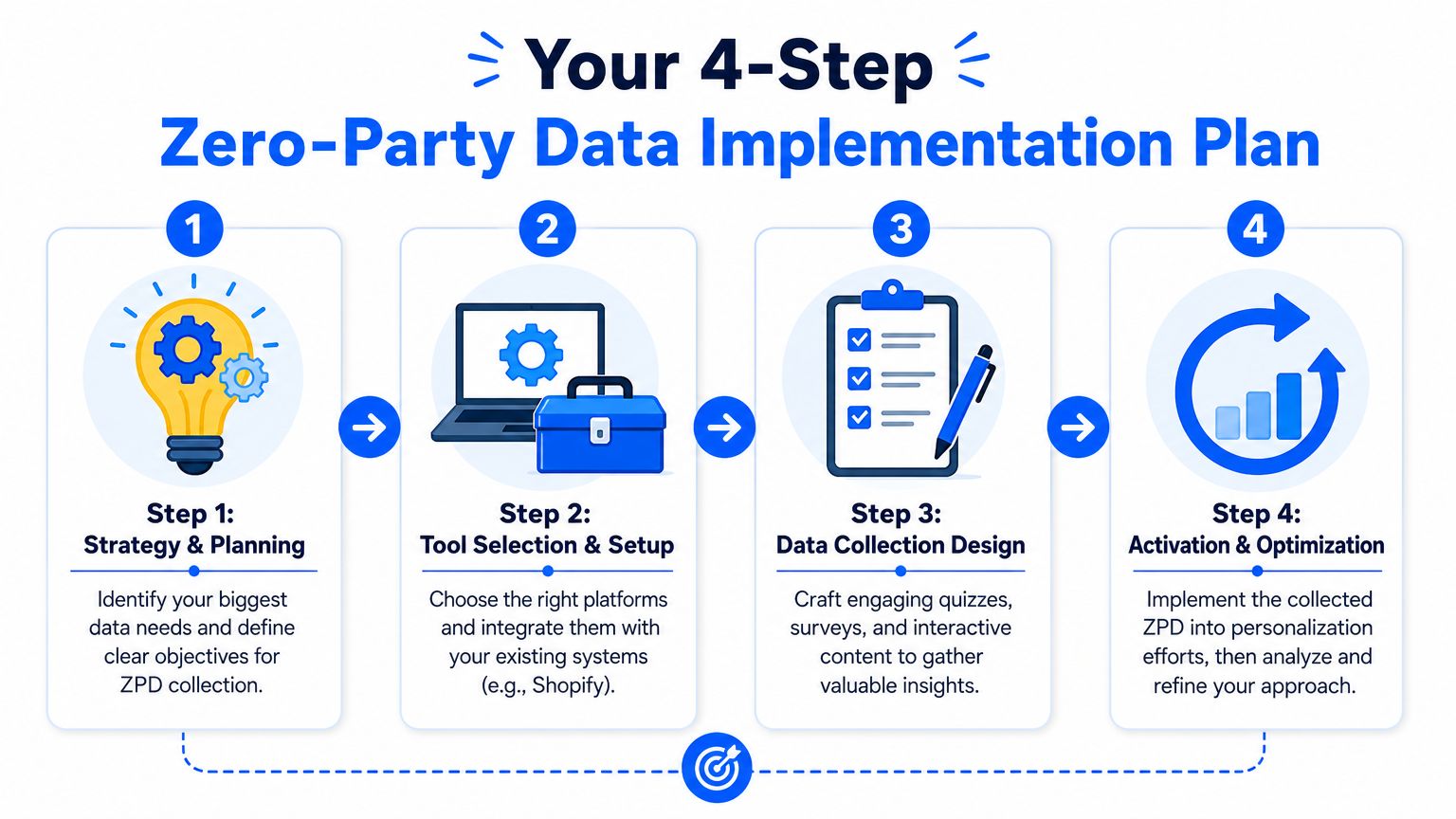
Step 1 Strategy and planning
Start with one question: what customer information would most improve your marketing if you had it today?
For one store, it's product intent. For another, it's fit preference. For another, it's whether the buyer is shopping for self, household, or gift. Pick the knowledge gap that affects the most decisions across product pages, lifecycle messages, or merchandising.
Don't start with demographics unless demographics directly change the experience. Decision variables usually matter more.
Step 2 Tool selection and setup
Choose a form or quiz tool that supports conditional logic, clean mobile UX, and straightforward deployment on Shopify. If you need a simple example of the kind of structure that works for segmentation and qualification, a lead capture form template built for progressive data collection is the right shape to evaluate.
Focus on mechanics:
- Can you ask one question at a time?
- Can later questions change based on earlier answers?
- Can you pass answers into your CRM or email platform as structured fields?
If the answer to those questions is no, the tool will create more manual work than value.
Step 3 Build and deploy
Write fewer questions than you think you need. Then remove one more.
Use direct language. Replace broad prompts with concrete ones. "What's your primary skin concern?" is better than "Tell us about your needs." "Which room is this fragrance for?" is better than "Share your preferences."
Deployment depends on intent:
- Put quizzes on landing pages when shoppers need help choosing
- Use embedded forms in content and collection pages
- Trigger popups only when the offer is clear
- Link to forms from email when you want to enrich existing contacts
Step 4 Integrate and test
At this point, many projects fail. The form launches, responses come in, and nothing useful happens next.
Map every answer to a destination before launch. Decide which field becomes a profile property, which answer triggers a flow, and which values create segments. Then test the full path. Submit the form, confirm the data arrives correctly, and check that the follow-up logic behaves as expected.
A zero-party data program isn't live when the form is published. It's live when the answer changes the next customer interaction.
Measuring Success and Activating Your New Data
A form completion report isn't enough. If the answers don't improve downstream performance or customer experience, the store is just collecting more fields.
CookieYes recommends tracking participation rate, data quality, and conversion impact as core KPIs, which is a useful operating lens even when your setup is simple, as noted earlier in the article. That's the right sequence. First ask whether people complete the flow. Then ask whether the answers are usable. Then ask whether they improve outcomes.
What to measure beyond completions
A practical review cadence should look at a few layers:
- Participation quality through completion patterns, skipped questions, and answer consistency
- Profile usefulness by checking whether responses create clean segments instead of messy free-text clutter
- Commercial impact through changes in recommendation relevance, campaign engagement, and purchase behavior
- Operational learning by spotting questions that create friction without producing action-worthy insight
The most revealing test is simple: did a declared preference change what the customer saw next?
If not, either the question was unnecessary or the activation setup is incomplete.
How to activate responsibly
Governance matters once you collect this data. One of the more neglected issues in zero-party data is what happens after collection, especially across consent, retention, and activation systems. The important principle is clear in The Channel Company's discussion of zero-party data governance: using the data responsibly, and delivering the value you promised, is central to preserving the trust that made collection possible.
That means:
- honor the context in which the customer shared the information
- don't overuse sensitive or intimate preference data
- let customers update preferences
- avoid sending campaigns that ignore what the customer explicitly told you
On the activation side, this usually means syncing fields into Klaviyo, Mailchimp, or your CRM so you can build segments and triggered flows. If you're tightening that handoff between forms, CRM, and messaging, Stamina's marketing automation insights offer a useful operational perspective on integration discipline.
The best activation is often subtractive, not just additive. Use 0 party data to suppress irrelevant sends, reduce message fatigue, and make each touchpoint feel earned.
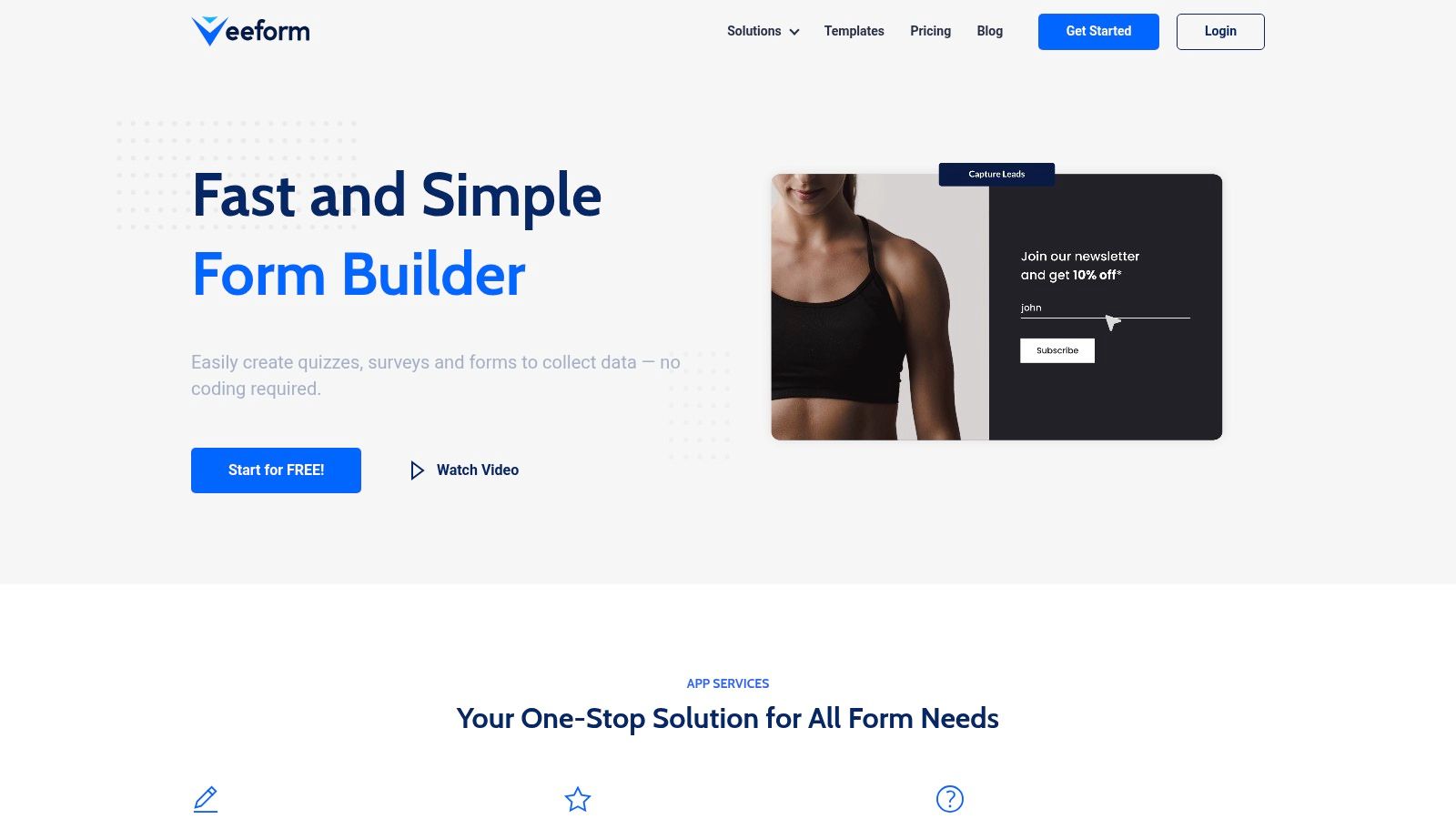
If you want to put this into practice quickly, VeeForm gives Shopify stores a clean way to build quizzes, sign-up flows, surveys, and product finders without a heavy setup. It's a practical option when you want to start collecting customer-declared preferences and turn them into better segmentation, smarter recommendations, and more relevant follow-up.
