You launched a quiz because the logic seemed obvious. Interactive content gets attention, shoppers like personalized recommendations, and B2B buyers will answer a few questions if the payoff is useful. The quiz starts getting completions. People click through. A few even share it.
Then revenue barely moves.
That's the point where most teams realize they didn't build a marketing asset. They built a novelty. Quizzes for marketing work, but only when they're tied to a commercial outcome you can measure: qualified pipeline, better product discovery, cleaner segmentation, stronger conversion paths, or a shorter path to purchase.
For Shopify brands, that usually means reducing choice overload and steering visitors toward the right SKU set. For SaaS teams, it means turning anonymous traffic into leads with enough context that sales or lifecycle marketing can act on it immediately. The quiz itself isn't the win. The win is what the quiz changes downstream.
Table of Contents
- Why Most Marketing Quizzes Fail to Deliver ROI
- Designing Quizzes That Convert Not Just Entertain
- From Concept to Live Quiz on Your Site
- Turning Quiz Takers into Qualified Leads
- Driving Traffic to Your New Marketing Quiz
- Measuring What Matters and Optimizing for Growth
Why Most Marketing Quizzes Fail to Deliver ROI
The failure usually isn't in quiz creation. It's in what happens after launch.
A team builds a quiz around a fun concept, gets a healthy number of starts, and treats completions as proof of success. But a completion isn't revenue. It isn't even necessarily intent. Without attribution, segmentation, and a clear post-quiz action, the quiz becomes another top-of-funnel asset that looks busy and performs vaguely.
That's what makes quizzes for marketing easy to overrate. A large-scale 2025 quiz marketing report from Riddle analyzed 3.13 billion answers and found that quizzes generated 3.02x more engagement and time on site than static content. That's powerful evidence that quizzes capture attention. It is not evidence, by itself, that they produce profitable customers.
The most engaging quiz isn't always the most valuable one. The most valuable quiz is the one that creates a clearer buying signal than your current form, landing page, or product grid.
The distinction matters more in Shopify and SaaS than in most categories.
A Shopify brand may use a product finder quiz to reduce abandonment on collection pages. That only pays off if the recommendations lead to stronger add-to-cart behavior, better conversion quality, or more relevant follow-up campaigns. A SaaS company may use a diagnostic quiz to qualify inbound interest. That only pays off if the answers improve routing, sales prioritization, demo quality, or nurture relevance.
Here's where many programs go wrong:
- They optimize for starts: A strong headline gets clicks, but the questions don't produce useful data.
- They collect trivia instead of intent: Answers are interesting, but not operational. Nobody can act on them in CRM, email, or sales.
- They stop at the result page: The user gets an answer, but no next step tied to revenue.
- They never benchmark against another path: The team can't tell whether the quiz improved conversion or just intercepted visitors who already intended to buy.
A quiz should function like part questionnaire, part routing engine, part conversion surface. If it can't improve segmentation or buying clarity, it probably belongs in a campaign, not in your core funnel.
Teams that are still using static lead forms often see why quizzes changed the conversation once they compare them with more guided marketing form flows. The interactive format can lower friction, but only if each answer helps the business make a better decision about what to show, who to contact, or which message to send next.
Designing Quizzes That Convert Not Just Entertain
A high-performing quiz isn't written like content. It's engineered like a funnel. The first decision isn't what questions to ask. It's what business outcome the quiz should produce.
Start with the commercial goal
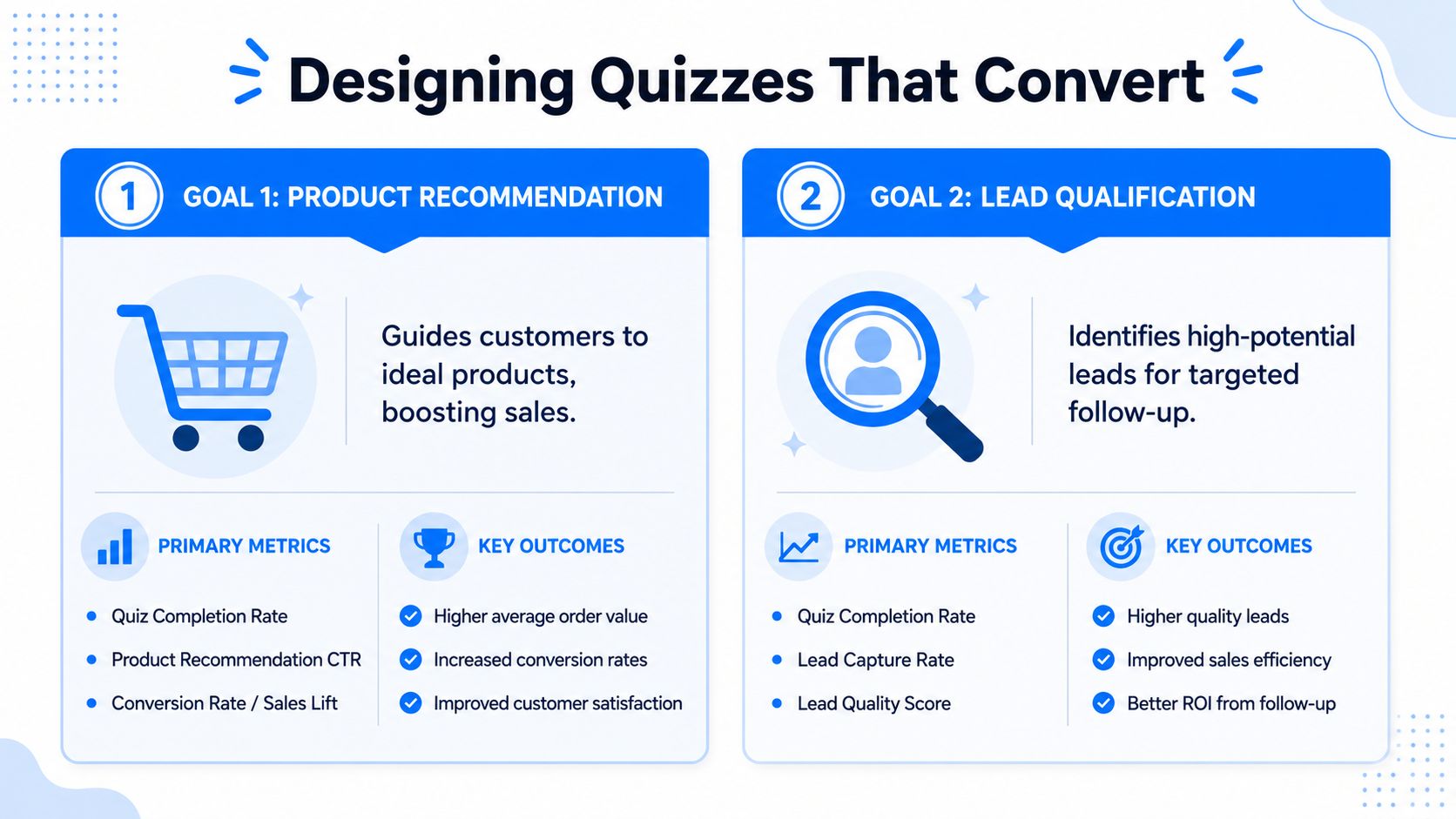
There are two common goals that justify quizzes for marketing.
The first is product recommendation. This is common in Shopify stores with broad catalogs or products that need interpretation. Think skincare, perfume, supplements, clothing, dog food, or home goods. The quiz helps the shopper narrow options and feel confident buying.
The second is lead qualification. This fits SaaS, agencies, consultants, and higher-consideration services. The quiz gathers context such as company stage, problem urgency, budget posture, team size, or desired use case, then routes the person to demo, sales, nurture, or self-serve content.
A Marquiz guide on quiz marketing notes that high-performing quizzes are typically built as a 5 to 8 question funnel that takes about three minutes to complete. It also recommends starting with easy, visual questions and using branching logic to keep the path relevant. That's useful because it forces discipline. If you can't get the answer you need in a short guided flow, your quiz is probably trying to do too much.
Choose the right quiz type
Different quiz formats solve different problems.
| Quiz type | Best fit | What it's good for | Where it fails |
|---|---|---|---|
| Personality | Brand engagement, style discovery, lighter segmentation | Gets attention, sparks sharing, introduces options | Weak if results don't map to products or follow-up journeys |
| Knowledge | Education, assessments, onboarding | Helps teach, diagnose maturity, reveal gaps | Can feel like work if used too early in acquisition |
| Recommendation | Ecommerce, SaaS qualification, guided selling | Directly supports buying decisions and segmentation | Fails if outcomes are too generic |
For most revenue-focused programs, recommendation quizzes outperform the other two because they connect answers to an action. In Shopify, that action might be “shop this bundle.” In SaaS, it might be “book the right demo path” or “see the implementation fit for your team.”
Practical rule: If you can't connect a quiz result to a product set, lead score, CRM tag, or next-step CTA, the quiz isn't ready to launch.
Write questions that earn better data
Good quiz questions feel helpful to the user and useful to the business. Bad quiz questions satisfy curiosity but don't improve the journey.
A few patterns work well.
- Start broad, then narrow: In a perfume store, begin with scent family before asking about wear occasion. In SaaS, begin with primary goal before asking about team workflow.
- Use answer choices that imply action: “Gift,” “daily use,” and “special occasion” are better than vague preference labels because merchandising can act on them.
- Ask for self-reported constraints: Budget range, timeline, or experience level can improve recommendations without feeling intrusive.
- Use visuals early: When users can answer quickly, momentum builds.
A Shopify skincare quiz might ask:
- What's your main skin concern?
- How does your skin usually feel by midday?
- Do you prefer a simple routine or a full regimen?
- Are there ingredients you avoid?
- What matters most right now: hydration, breakouts, sensitivity, or texture?
A SaaS qualification quiz might ask:
- What are you trying to improve first?
- Which team would own this workflow?
- Are you replacing a current tool or starting from scratch?
- What matters more right now: speed, reporting, or control?
- How soon do you need a solution live?
Notice what these questions do. They don't just describe the user. They help decide what recommendation to show, how to position value, and what kind of follow-up belongs next.
From Concept to Live Quiz on Your Site
Once the strategy is sound, the build should stay simple. It's common to lose time polishing visuals before the path, the logic, and the placement are locked.
Build the flow before you style it
Start with five components on a plain document or whiteboard:
- Entry point
- Question path
- Branching rules
- Lead capture moment
- Result outcomes
That order matters because the structure determines performance more than decorative design does.
A no-code builder such as VeeForm's AI form generator can speed up the initial draft, especially if you already know the quiz's job. The useful part isn't that it creates questions quickly. It's that it gives the team something concrete to critique: what should be asked, what should be skipped, and what outcome each answer should produce.
For execution, keep the interface mobile-first and present one question at a time. That format reduces visual clutter and makes progress feel easier. On a phone, especially, stacked multi-question layouts create unnecessary fatigue.
Use conditional logic to shorten the path
Conditional logic is where modern quizzes stop feeling generic.
A Shopify example makes this clear. If a skincare shopper selects oily skin, the next question might ask about breakouts, shine, or pore concerns. If the same shopper selects sensitive skin, the next step should shift toward irritation triggers, fragrance tolerance, or preferred routine simplicity. The quiz gets shorter for the user and smarter for the business.
In SaaS, if the respondent says they're a solo operator, you may skip questions about admin controls or cross-functional approvals. If they identify as part of a larger team, those questions become relevant because implementation complexity changes the sales motion.
Shorter isn't always better. More relevant is better. Branching logic earns completion because it removes questions that don't belong.
A good conditional flow also improves data quality. People answer more accurately when the quiz reflects their situation instead of forcing them through a canned sequence.
Here's a practical build checklist:
- Map every branch to a business reason: Don't add logic because the builder supports it.
- Keep answer labels distinct: Overlapping options create muddy segmentation later.
- Make every result page specific: Generic outcomes weaken trust.
- Test on mobile before launch: Thumb reach, image scaling, and button spacing matter more than desktop polish.
A quick product walkthrough is often easier to understand than documentation alone:
Choose placement based on buying intent
Where you place the quiz changes who takes it and why.
On a product or collection page works well when shoppers are clearly in evaluation mode. This is ideal for recommendation flows tied to purchase intent.
Behind a button click works when the quiz is helpful but not the primary page action. It lets users opt in without hijacking the page.
In an exit-intent popup works when visitors are about to leave and still seem undecided. This placement is often strongest when framed as guidance, not as a discount interruption.
For SaaS, embedding a qualification quiz on a pricing page can work well because that page attracts higher-intent visitors. For Shopify, a quiz link in a sticky bar can work when the product range is broad and first-time visitors need help choosing.
Turning Quiz Takers into Qualified Leads
A completed quiz is useful. A completed quiz tied to lead routing is where the economics start to change.
Many teams still treat the opt-in form as an afterthought. That's a mistake. The form is not an administrative step. It is the moment where the user decides whether the value of the result is worth continuing the relationship.
Ask for contact details at the moment of highest intent
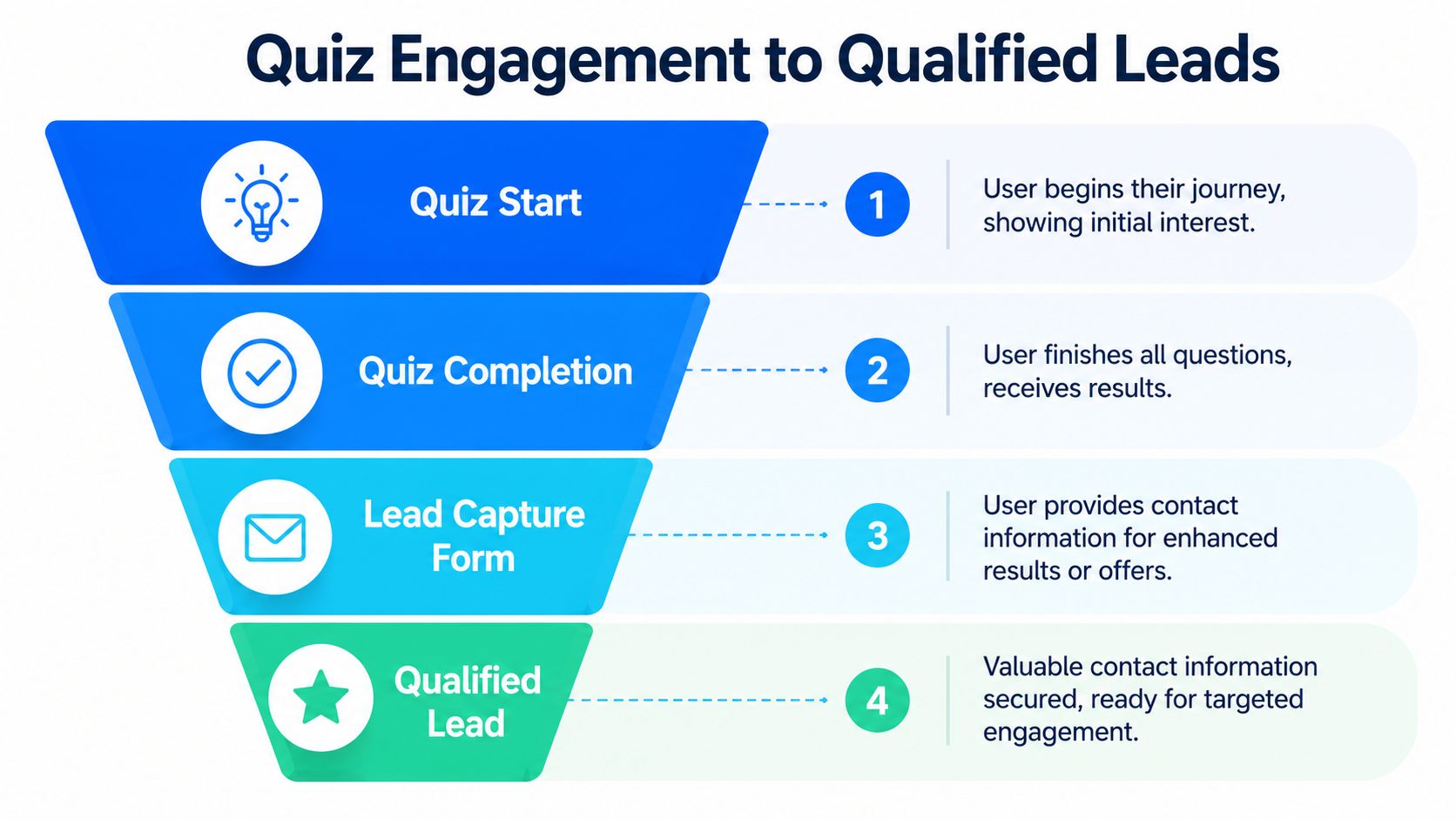
For most lead generation quizzes, the strongest placement for the form is near the end, just before expanded results, personalized recommendations, or a specific offer. By then, the user has already invested effort and expects value in return.
An ActiveCampaign article on quizzes for lead generation notes that lead generation quizzes can achieve opt-in rates of up to 55% when the form is kept to five fields or fewer and the quiz balances roughly 75% image-based content with a lean 6 to 8 question structure. That's a useful operating principle: keep the ask small, keep the quiz visually easy, and make the handoff feel earned.
You don't need every field up front. In many programs, email plus one operational field is enough to continue the journey. If sales needs more context, enrich the profile later through CRM sync, follow-up forms, or direct outreach.
A short lead capture form template can help teams avoid the common problem of overbuilding this step.
Turn answers into routing rules
Quizzes stop being content and start acting like infrastructure.
For SaaS, each answer should map to a decision:
- High budget or urgent timeline: Route to sales fast.
- Low urgency but strong fit: Place in a nurture flow with use-case content.
- Poor fit: Redirect to self-serve education or a lower-friction offer.
For Shopify, answers should shape merchandising and lifecycle marketing:
- Preference segment: Trigger personalized product recommendations.
- Use case segment: Send a follow-up sequence tied to occasion, concern, or benefit.
- Price sensitivity: Adjust the product set or promotion angle.
A quiz answer has no business value until a system does something with it.
That “something” can be small. Tag the lead. Personalize the result page. Change the CTA. Trigger a segment in Klaviyo, HubSpot, or another CRM. But the handoff has to be intentional.
A simple example from SaaS makes the point. If a respondent selects a larger budget, a near-term timeline, and a reporting-heavy use case, that lead should not receive the same email sequence as someone exploring options casually. The same quiz produced two very different next steps. That's the point of running the quiz at all.
Driving Traffic to Your New Marketing Quiz
A solid quiz can still underperform if the wrong people see it, or if the right people see it in the wrong context. Distribution should follow friction.
Promote it where decision friction already exists
Start on your own properties. That traffic is the easiest to align with intent because you already know where visitors hesitate.
For Shopify, strong placements include collection pages with lots of variation, buying guides, gift pages, and product education content. If shoppers repeatedly bounce between categories, a recommendation quiz can act as guided navigation instead of another promotional block.
For SaaS, useful placements include pricing pages, comparison pages, solution pages, and blog posts tied to a defined problem. A “find the right plan” or “assess your workflow fit” quiz usually performs better there than on a generic homepage banner.
A practical on-site rollout often includes:
- Homepage support: Add a clear path for first-time visitors who don't know where to start.
- Inline blog CTAs: Place a quiz inside relevant educational articles, not just at the end.
- Sticky bars or slide-ins: Surface the quiz without forcing it on every session.
- Support and help content: Use quizzes to turn confused traffic into guided discovery.
If you're planning broader promotion, it helps to review effective content repurposing techniques. The same quiz can become email copy, paid social creative, blog upgrades, short-form video hooks, and segmented follow-up offers without inventing a new campaign from scratch.
Match channel to quiz intent
Different channels support different quiz types.
Email works best when you already have some audience context. Send a recommendation quiz to category browsers. Send a diagnostic quiz to leads who downloaded a related asset. The quiz should feel like the next logical step, not a reset.
Organic social works when the quiz promise is immediately understandable. Product recommendation angles often do better than abstract assessments because the payoff is concrete.
Paid social works when the result is specific and the audience can self-identify fast. “Find your ideal routine” is stronger than “Take our brand quiz.” For LinkedIn, a SaaS qualification quiz should lead with a business problem, not novelty.
Retargeting is often the best first paid use case. A quiz can rescue uncertain visitors better than another product ad or another generic demo CTA because it changes the experience from passive browsing to guided choice.
One warning. Don't distribute a quiz as if it were a standard content asset. It needs a promise. What will the person get at the end, and why is that outcome worth a few minutes? If that answer isn't obvious in the promotion itself, traffic quality drops fast.
Measuring What Matters and Optimizing for Growth
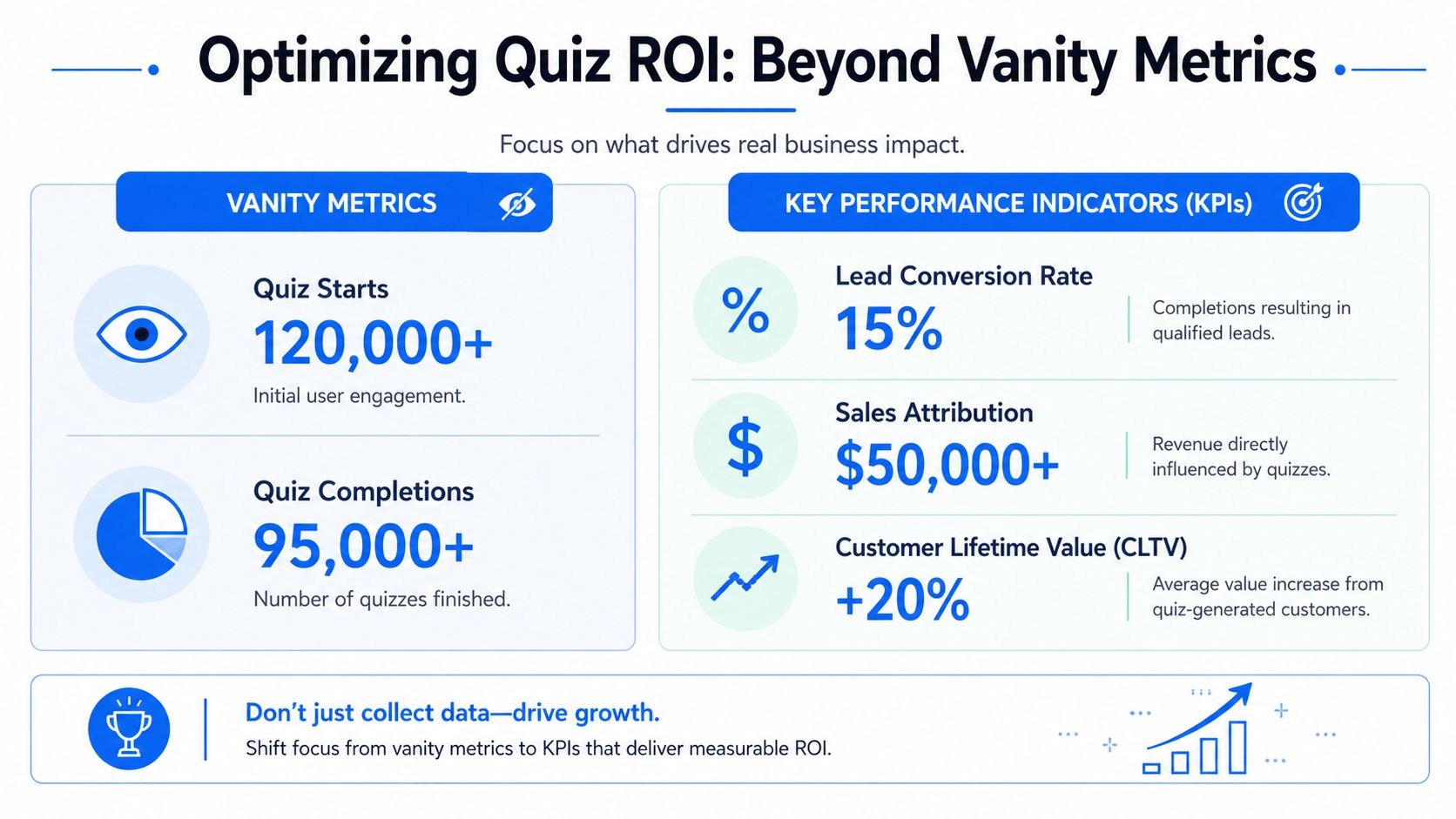
If your quiz dashboard ends at starts, completion rate, and a pile of answers, you don't have measurement. You have activity reporting.
Revenue-focused quiz programs need a different scorecard.
Track business KPIs before engagement metrics
Start with the outcomes that matter after the quiz, not just inside it.
For SaaS, that usually includes lead quality, sales acceptance, opportunity creation, and conversion from quiz segment to pipeline. For Shopify, it usually includes add-to-cart quality, purchase rate after quiz completion, recommended product uptake, and post-quiz average order behavior.
You still need funnel health metrics, but they are diagnostic, not the finish line. A good operating set looks like this:
- Completion rate: Tells you whether the flow is too long, confusing, or poorly matched to traffic.
- Drop-off by question: Shows where friction enters the path.
- Lead capture rate: Reveals whether the value exchange is strong enough.
- Segment-level conversion: Shows which outcomes drive revenue.
- Post-quiz conversion behavior: Tells you whether the quiz changed the buying journey.
If you run ecommerce, it also helps to compare quiz performance against your wider store dashboard. A practical reference point is this guide to essential ecommerce KPIs, especially when you want to connect quiz-influenced sessions to broader merchandising and retention outcomes.
Use benchmarks carefully
Benchmarks are useful when they create discipline, not when they replace thinking.
A Digioh guide to quiz funnels recommends aiming for a 70%+ completion rate, a 20 to 55% lead-capture rate, and expects quiz-driven traffic to convert at 2 to 5x a site's average conversion rate. Those numbers are helpful because they frame what “healthy” can look like.
But they are not a pass-fail verdict.
A highly qualified SaaS quiz may complete at a lower rate and still be more profitable because it filters aggressively. A Shopify quiz may produce excellent recommendation quality even if the first version underperforms on capture rate. Context matters. Offer strength matters. Traffic source matters.
Treat benchmarks as operating ranges, not promises. The useful question isn't “Did we hit the benchmark?” It's “Did the quiz beat the non-quiz path for this audience and this intent?”
Optimize the questions and the outcome page
The best gains often come from removing friction, not adding cleverness.
Look first at drop-off points. Long text prompts, confusing answer choices, and irrelevant branches usually create the steepest exits. If a specific question loses momentum, rewrite it, replace it with a visual choice, or remove it entirely.
Then look at the result page. Too many teams spend all their time on question design and leave the outcome generic. That's backwards. The results page is where the quiz cashes in its effort.
A strong optimization cycle usually includes:
- Testing result page CTA language: “Shop your routine” and “See recommended bundle” can perform differently.
- Changing question order: Early momentum often improves when easy visual choices come first.
- Refining segment logic: If one answer bucket produces weak downstream conversion, the recommendation may be wrong.
- Comparing quiz path versus non-quiz path: The only honest ROI test is whether the quiz improves the baseline journey.
For mature teams, the next step is attribution discipline. Compare quiz completers against non-quiz visitors with similar entry sources. Track whether quiz-informed segments outperform your general list in email, onsite conversion, or sales follow-up. That's the work most quiz content ignores, and it's the part that turns an interactive asset into a dependable growth channel.
If you want to build quizzes for marketing without custom development, VeeForm is one option for creating product recommendation flows, lead qualification quizzes, and embedded or popup experiences that sync responses into your workflow.
