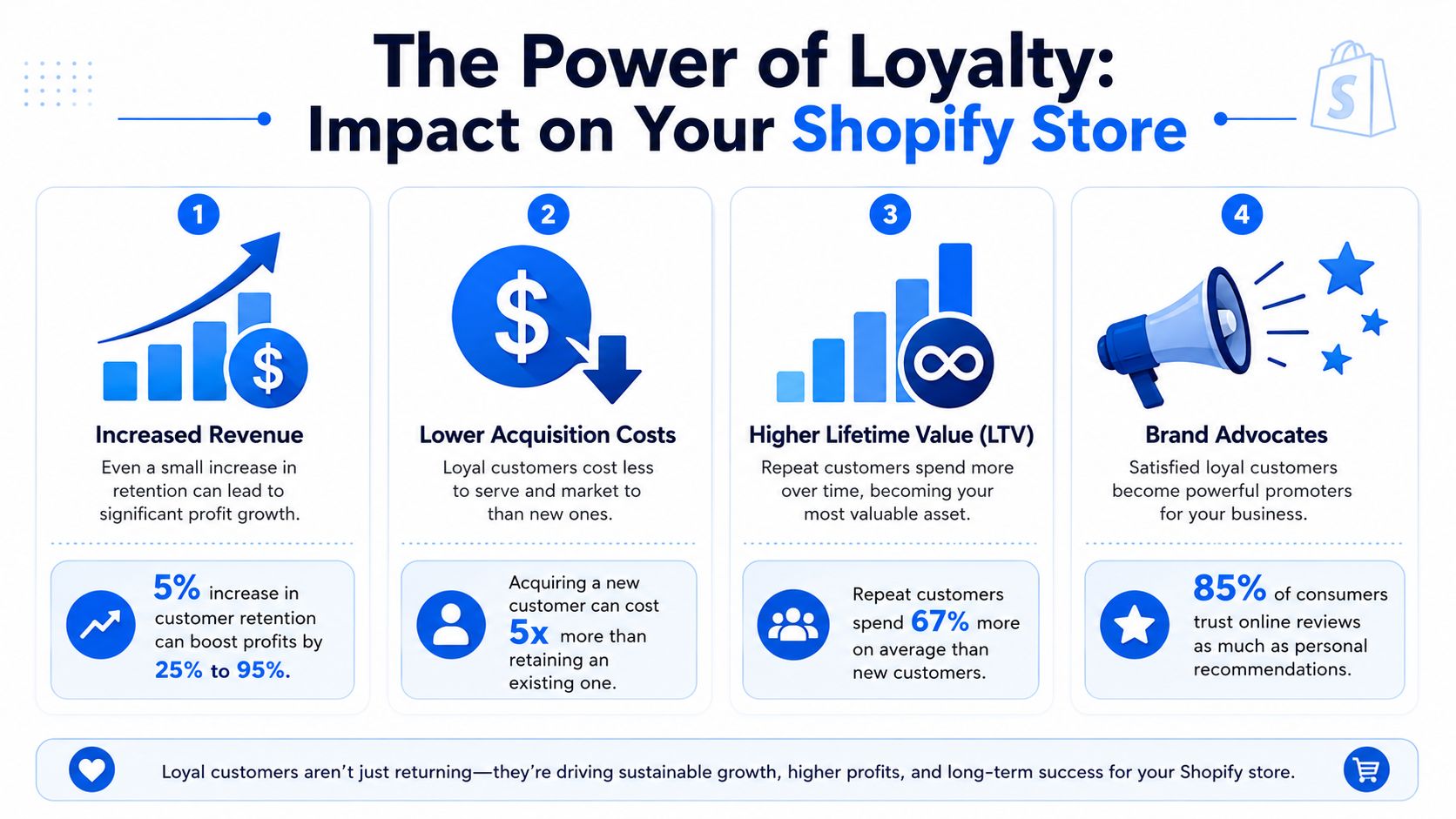
Retaining a customer is still one of the cleanest profit levers in e-commerce. A long-cited benchmark says keeping an existing customer costs about 5 times less than acquiring a new one, and that a 5% increase in retention can raise profits by 25% to 95%, according to Sprinklr's customer retention statistics roundup. For a Shopify store, that changes the conversation. Retention isn't a support metric. It's a growth model.
Most stores already know the usual advice. Send better emails. Launch a loyalty program. Personalize recommendations. The problem is execution. You can't personalize much if you don't know who the customer is, what they care about, why they bought, how they use the product, or what made them hesitate. That's where forms, quizzes, and surveys become more than list-building tools. They become your zero-party data engine.
The strongest customer loyalty and retention systems on Shopify don't start with discount logic. They start with structured customer input collected at the right moments, then turned into segments, automations, and offers that fit.
Table of Contents
- The True Cost of a Lost Customer
- Customer Loyalty vs Customer Retention What Is the Difference
- The Business Impact of Loyalty and Retention on Shopify
- Proven Strategies to Build Lasting Customer Loyalty
- How to Drive Retention with Interactive Content
- Actionable Retention Workflows for Shopify Merchants
- Measuring and Optimizing Your Retention Engine
The True Cost of a Lost Customer
A lost customer rarely shows up as a single missed order. It shows up as wasted acquisition spend, lower repeat purchase volume, thinner margins, and a bigger burden on your paid channels.
That matters because many Shopify teams still manage growth as if acquisition and retention are separate. They aren't. When retention is weak, you have to keep replacing churn with new traffic. When retention improves, every paid click has more downstream value.
Loyalty and retention aren't the same thing
Retention is the outcome. The customer comes back and buys again.
Loyalty is the reason. The customer prefers your store, trusts your product, and doesn't immediately compare you against five alternatives the next time they need something.
That difference changes how you operate. Retention can be pushed temporarily with timing, reminders, subscriptions, and offers. Loyalty takes stronger inputs: product fit, relevance, trust, and a customer experience that feels like it was built for the buyer rather than for your campaign calendar.
Practical rule: If your store only knows what someone bought, but not why they bought it, your retention strategy is missing the most useful layer of data.
Why Shopify stores hit a ceiling
Many stores plateau after the first repeat purchase because they rely on generic post-purchase flows. Every customer gets the same welcome sequence, the same replenishment timing, the same cross-sell logic, and the same win-back discount.
That works for a while. Then it stops.
A dog food brand needs to know pet size, diet sensitivity, and feeding schedule. A fragrance brand needs scent preferences, gift intent, and seasonality. An apparel brand needs fit preferences, style goals, and occasion. Without that information, "personalization" becomes little more than product blocks pulled from order history.
Forms, quizzes, and surveys solve that gap. They let you ask customers directly, then use those answers to drive segmentation, messaging, and merchandising decisions across the lifecycle.
Customer Loyalty vs Customer Retention What Is the Difference
If retention is the second order, loyalty is what makes the customer stop shopping the category and start shopping your brand first.
A simple way to think about it is this. Retention answers whether they came back. Loyalty answers why they wanted to.
Loyalty vs Retention At a Glance
| Dimension | Customer Retention | Customer Loyalty |
|---|---|---|
| Core idea | Continued purchasing over time | Preference and attachment to the brand |
| Primary signal | Repeat orders, renewals, lower churn | Repeat choice, advocacy, resistance to switching |
| Time horizon | Often measured over defined periods | Built across many interactions |
| Main drivers | Convenience, reminders, offers, habit | Trust, relevance, product fit, value, experience |
| Typical risk | Can be shallow and discount-dependent | Harder to build, but more durable |
| Shopify question | “Did they buy again?” | “Would they choose us again without being pushed?” |
Why the distinction matters on Shopify
A lot of retention reporting hides the underlying issue. A store can have acceptable repeat purchase rates and still have weak loyalty. Customers might be returning only for one replenishment cycle. Or they may buy from one product category repeatedly but never expand into higher-margin lines.
That creates what I think of as fragile retention. Orders keep coming in, but the relationship isn't deepening.
The opposite also happens. A customer may be loyal in attitude, but not frequent in transactions. They like the brand, read emails, and trust the product, yet only shop in narrow use cases. Those customers need a different strategy than pure win-back logic. They need prompts that surface adjacent needs, category education, and offers matched to what they're trying to solve.
Retention tells you what happened. Loyalty helps you predict what the customer is likely to do when a competitor offers a lower price.
What weak teams confuse
Three mistakes come up constantly:
- They treat discounts as loyalty. Discounts can keep people around, but they often train the customer to wait.
- They overvalue average retention rates. A blended number can hide whether first-time buyers are churning fast while older cohorts remain stable.
- They guess at intent. They infer from clicks and orders when a short form could have given them the answer directly.
For Shopify merchants, customer loyalty and retention work best as a sequence. First, reduce friction so customers return. Then collect enough zero-party data to make each next interaction more useful. Over time, that repeated relevance is what creates preference.
The Business Impact of Loyalty and Retention on Shopify
Shopify growth gets healthier when repeat revenue becomes less dependent on paid reacquisition. That's the operational impact of stronger customer loyalty and retention. You protect margin, improve lifetime value, and reduce how often every campaign has to start from zero.
Loyalty is becoming more conditional
Recent loyalty data makes this even more important. In 2025, 68% of consumers said they were loyal to certain brands, but that marked the first decline in true loyalty in five years, down 5% from 2024. The same data found that 60% switched from a brand because of cost, while 59% named high-quality products as the top driver of loyalty, according to Emarsys' 2025 customer loyalty statistics.
That combination matters. Customers still commit to brands, but they do it with more conditions attached. Price matters. Product quality matters. Perceived value matters. Habit alone won't hold them.
What this means for Shopify operators
For Shopify stores, this shows up in very practical ways:
- Your merchandising matters more. If customers can't quickly find the right product, loyalty weakens before support ever hears about it.
- Your post-purchase experience matters more. Quality has to be reinforced after the order, not just claimed on the product page.
- Your creative matters more. Better visuals reduce hesitation and make value easier to communicate. If your store is improving product presentation, this guide on AI imagery for higher conversions is a useful companion because retention often starts with getting the first purchase context right.
One reason I push teams to treat retention as a growth system is that it creates compounding benefits. Buyers who return are easier to segment, easier to educate, and easier to cross-sell because you already have some relationship to work with. But that only happens if the store keeps learning from each interaction.
A Shopify store with broad SKU depth has an extra challenge. Customers don't just need reasons to return. They need reasons to move across categories, build habits, and see more of your catalog as relevant. That's where interactive data collection becomes operational, not decorative.
Proven Strategies to Build Lasting Customer Loyalty
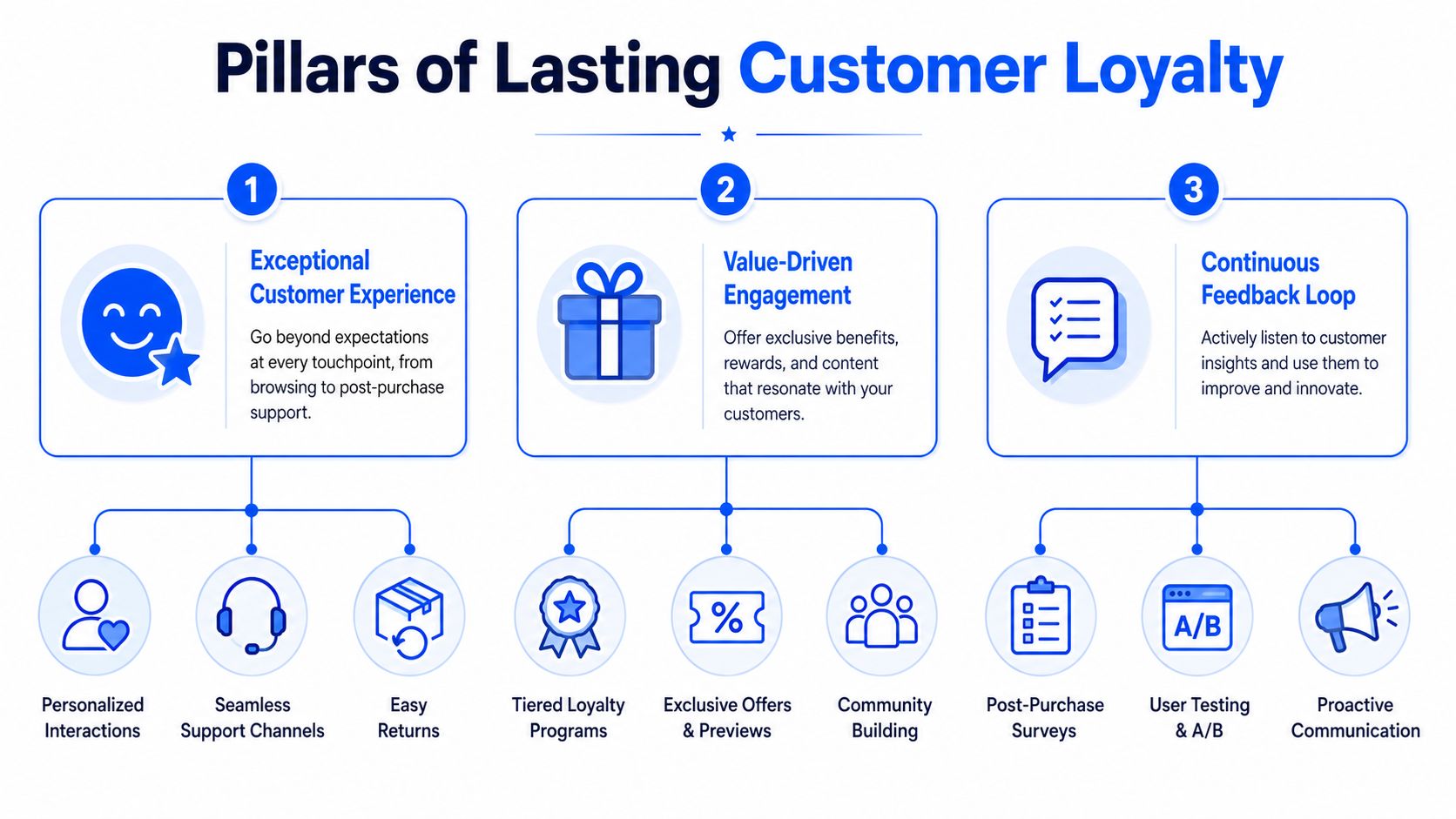
Strong loyalty doesn't come from one tactic. It comes from a system. On Shopify, that system usually rests on three pillars: a clean customer experience, personalization based on real inputs, and a value exchange that gives people a reason to stay engaged.
Build the experience first
No loyalty program can compensate for friction in the basics. If product discovery is confusing, shipping expectations are unclear, returns feel difficult, or support responses don't solve the issue, your retention engine will keep leaking.
On Shopify, the experience layer includes:
- Product-fit clarity: Shoppers need help choosing the right size, formula, scent, shade, or bundle.
- Post-purchase guidance: Customers should know how to use, care for, or get the most from what they ordered.
- Support routing: Forms can triage intent before a support ticket becomes a frustration spiral.
Use data to personalize without guessing
Most stores talk about personalization while running broad segments. They personalize with first-name merge tags and product blocks. That's not enough for stores with variation-heavy catalogs.
Zero-party data gives you cleaner inputs:
- Preference data from quizzes
- Motivation data from surveys
- Context data from forms, such as self-purchase versus gift, routine versus one-off, beginner versus advanced
That data is what helps you cultivate lasting customer loyalty in a way that isn't dependent on blanket discounting. It tells you what kind of follow-up belongs to each customer, and just as important, what doesn't.
The fastest way to make retention feel generic is to automate before you've learned enough about the buyer.
Make the value exchange obvious
Customers give you attention and information when they understand what they get back. That exchange has to be clear.
Sometimes the exchange is direct: a product recommendation quiz that saves time. Sometimes it's ongoing: early access, useful education, a better replenishment flow, or rewards that match real buying behavior rather than vanity actions.
What doesn't work well is asking for data too early without enough context. A long preference survey before trust exists often depresses completion. A well-timed one-question prompt after browsing or immediately after delivery usually performs better because the customer can see the purpose.
The practical takeaway is simple. Don't ask for data because your CRM wants more fields. Ask for it because the next customer experience will become measurably more relevant.
How to Drive Retention with Interactive Content
Interactive content is where customer loyalty and retention become operational. Instead of inferring everything from clicks, you ask customers directly, then wire those answers into Shopify flows, email segments, support rules, and recommendation logic.
A practical setup usually includes three assets: a post-purchase survey, a product recommendation quiz, and an onboarding form for new subscribers or first-time buyers. Those assets don't need to be complicated. They need to ask the right questions at the right point in the journey.
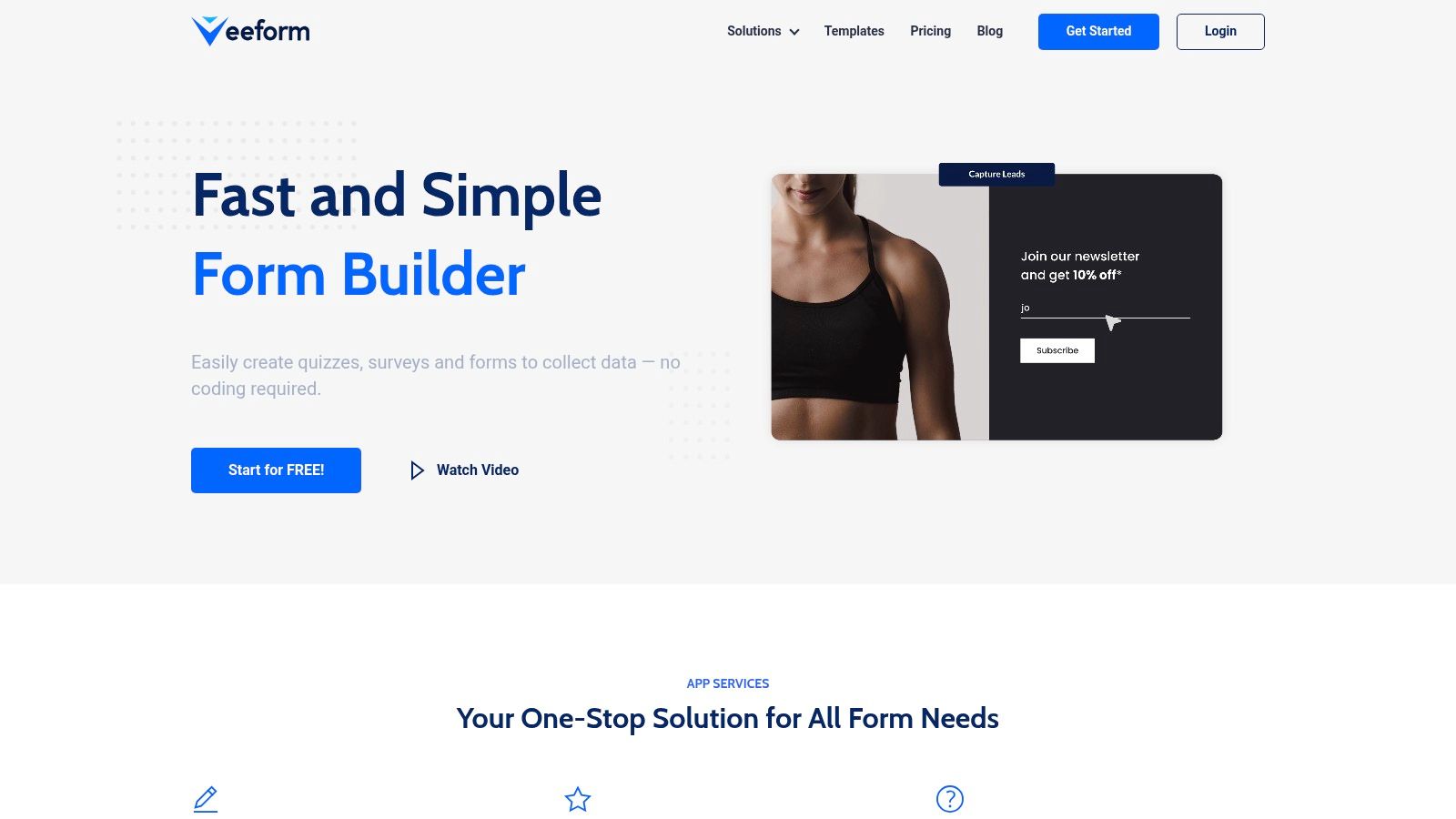
One option for building these flows is VeeForm's AI form generator, which can be used to create quizzes, surveys, and sign-up forms for Shopify use cases such as product matching, feedback capture, and lifecycle segmentation.
Post-purchase surveys that improve the next order
Most stores ask for a review too early and learn too little. A short post-purchase survey is more useful because it can capture context that a star rating never reveals.
Ask questions like:
- Purchase intent: Was this for yourself or a gift?
- Decision factor: What mattered most when choosing?
- Usage context: When and how do you plan to use it?
- Friction point: What almost stopped you from ordering?
Those responses can feed practical actions. Gift buyers can receive gifting reminders and seasonal bundles. Self-buyers can receive replenishment or usage education. Customers who flagged hesitation about sizing, ingredients, or shipping can be routed into reassurance content rather than generic promotions.
Product quizzes that guide the first and second purchase
Quizzes are especially valuable for stores with high choice complexity. Perfume, skincare, supplements, pet products, apparel, and home goods all benefit from guided selling because the buyer often struggles to translate preferences into products.
A good quiz does two jobs. It helps the shopper buy now, and it gives the brand reusable preference data for later retention campaigns.
For example:
- A fragrance brand can ask about scent family, intensity, occasion, and whether the purchase is personal or a gift.
- An apparel brand can ask about fit preference, use case, and styling priorities.
- A dog food brand can ask about breed size, sensitivities, age, and feeding routine.
That preference capture can later support content aimed at category expansion, refill timing, and even building brand advocates by identifying customers who are satisfied enough to review, refer, or share.
Ask fewer questions, but make each answer usable. If a response won't change a segment, recommendation, or workflow, leave it out.
Later in the lifecycle, video can help explain how these interactive flows fit together with automation and segmentation:
Onboarding forms that create better segments from day one
The biggest missed opportunity in Shopify retention is poor segmentation at signup. Stores collect an email address, maybe a phone number, and nothing else. Then they try to infer everything from browse behavior.
A better approach is a lightweight onboarding form that captures one or two high-value attributes. For a fashion store, that might be style interest or shopping occasion. For a pet brand, it might be pet type and age. For a beauty brand, it might be concern area or routine level.
The result is better messaging from the start:
- Welcome flows become more relevant
- Campaign targeting improves
- Product education can match actual customer needs
- Win-back messages can reference original intent instead of guessing
Interactive content works because it closes the gap between what the customer knows about themselves and what your store knows about them. That's the raw material modern retention needs.
Actionable Retention Workflows for Shopify Merchants
A single quiz or survey is useful. A full workflow is where it starts paying off. The key is to trigger workflows from behavior change, then enrich them with direct customer input.
Quantum Metric recommends using behavior-change signals such as declining engagement, fewer purchases, and changing buying behavior to spot risk early and trigger proactive interventions like targeted offers or rewards in its guidance on practical customer retention analytics.
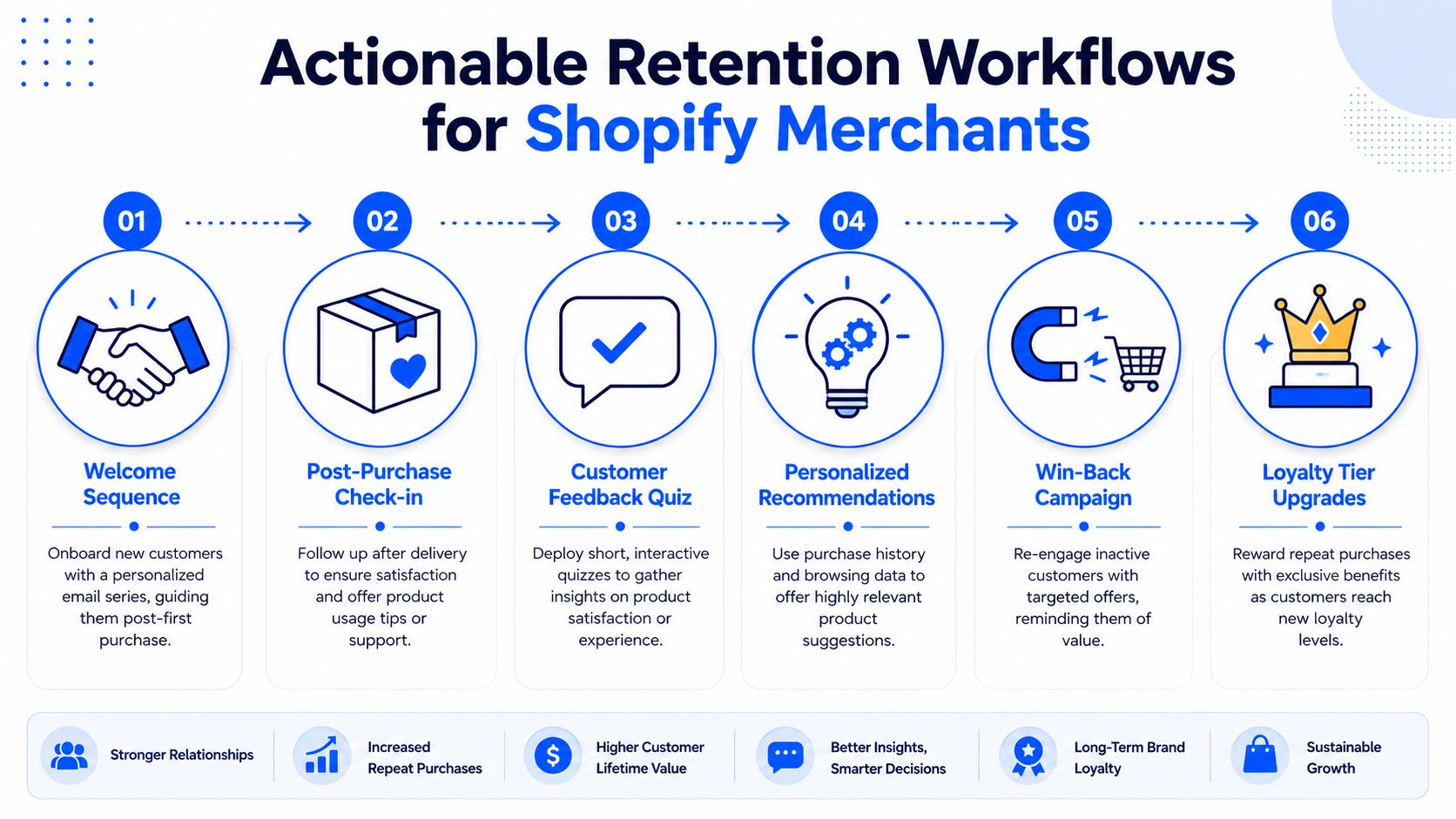
Workflow one post-purchase feedback and recovery
A customer's order is delivered. A short check-in goes out asking whether the item met expectations and whether anything was unclear.
If the customer reports a problem, route them to support with context attached. If they report satisfaction, tag them for category follow-up, reorder messaging, or review requests.
A simple newsletter signup form template can be part of a broader capture strategy. Stores often start with email acquisition, then extend the same logic into post-purchase surveys and preference collection instead of treating signup as a one-time event.
Workflow two proactive win-back based on behavior change
This flow starts before churn is final. A customer who used to open emails, browse product pages, or reorder on a rough cadence starts going quiet.
Instead of sending a generic discount, send a short survey asking what changed. The best answers usually fall into familiar buckets: price sensitivity, too much product left, confusion about fit, low engagement with recent launches, or shifting needs. Each answer deserves a different follow-up.
A useful sequence looks like this:
- Detect the change: Lower engagement or fewer purchases trigger the flow.
- Ask one focused question: Why haven't you come back yet?
- Branch the response: Education, reassurance, category reminder, or a targeted offer.
- Measure return behavior: Watch whether the customer re-engages after the specific intervention.
Workflow three cross-sell through preference capture
Cross-sell usually fails when it's based only on what other customers bought. That's broad merchandising, not retention strategy.
A stronger flow begins with a category-specific quiz or follow-up form. If someone buys a running jacket, ask whether they need layering, visibility, or wet-weather support. If they buy premium dog food, ask about treats, supplements, or feeding challenges. The answer should determine the recommendation path.
Stores with large catalogs often don't have a retention problem. They have a relevance problem.
This kind of workflow is especially useful for merchants with many SKUs because it helps customers migrate across categories instead of staying stuck in one buying lane.
Measuring and Optimizing Your Retention Engine
Retention work gets expensive when teams optimize the wrong view of the business. Aggregate repeat rate can look stable while first-time buyers churn, mature cohorts flatten, or long-term customers stop expanding their basket.
Track the right formulas
Zendesk recommends calculating retention as customers at end of period minus new customers acquired during the period, divided by customers at the start of the period. It also notes that, for subscription businesses, retention benchmarks commonly fall in the 75 to 90% range, which is why cohort-level churn monitoring matters in its guide to customer retention measurement.
You should also track churn as lost customers divided by starting customers. Those two metrics give you the basic health check. They don't tell you where the problem lives.
Use cohorts to find hidden problems
Cohort analysis is what turns retention from a dashboard metric into a diagnosis. Segment customers by acquisition period, first product purchased, discount exposure, or quiz outcome. Then compare how those groups behave over time.
Useful questions include:
- Which first-purchase categories create the strongest repeat behavior
- Which acquisition periods bring in customers who stall quickly
- Which customer segments expand into a second category
- Which survey responses correlate with stronger repeat intent
A simple feedback tool like a shopping experience feedback form can help fill in the qualitative layer that order data misses, especially when a cohort underperforms and the reason isn't obvious from clickstream behavior alone.
Watch for quiet loyalists
One of the hardest retention patterns to spot is the quiet loyalist. This customer isn't gone. They still like the brand. They may even buy again. But they stop progressing.
Maybe they only reorder one SKU. Maybe they never move into bundles. Maybe they ignore new launches. This isn't a classic churn problem. It's a depth problem.
The right move isn't always a stronger incentive. Often it's a survey that asks what else they're interested in, what they've never been able to choose confidently, or what would make the next purchase easier. That kind of direct input tells you how to increase purchase progression without over-discounting.
If you're building a Shopify retention engine around quizzes, surveys, and forms, VeeForm is one practical option for collecting zero-party data and turning it into segments, feedback loops, and guided product journeys. It fits stores that need faster experimentation without custom development, especially when the goal is to ask better questions and use the answers across the customer lifecycle.
