A shopper lands on your perfume store, clicks through a few product pages, reads “warm,” “fresh,” “woody,” and still has no idea what to buy. That's the normal failure mode of online fragrance retail. The catalog looks polished, but the buyer can't smell anything, can't compare confidently, and doesn't want to gamble on the wrong bottle.
That's why a perfume recommendation quiz works so well when it's built as a revenue system instead of a novelty widget. The best ones shorten the path from uncertainty to purchase, turn subjective taste into usable merchandising logic, and give your team cleaner data to improve email, paid traffic, and product positioning over time. If you run Shopify, the key opportunity isn't just “more engagement.” It's a better funnel from first click to repeat order.
Table of Contents
- Why Your Perfume Store Needs a Recommendation Quiz
- Planning Your Quiz for Maximum Conversion
- Designing a Compelling and Brief Question Flow
- Building the Quiz and Mapping Product Logic
- Launching and Promoting Your Perfume Quiz
- Measuring Success and Optimizing for Revenue
Why Your Perfume Store Needs a Recommendation Quiz
Fragrance is one of the hardest categories to sell online because the customer has to imagine the product before they can trust it. In skincare, shoppers can compare ingredients. In apparel, they can check fit photos. In perfume, they're trying to translate words into a sensory decision.
That gap creates hesitation. Hesitation kills conversion.
A perfume recommendation quiz solves that by acting like a guided merchandiser. Instead of asking the shopper to sort through every bottle, it narrows choices based on preference signals and presents a smaller, more believable recommendation set. That's not a fringe tactic anymore. Major direct-to-consumer brands such as ScentBox, DefineMe Fragrance, and Sol de Janeiro use fragrance-finder experiences as part of the shopping funnel, not as an afterthought, as shown by ScentBox's fragrance finder approach.
It reduces cognitive load at the moment buyers stall
Most perfume stores have the same structural problem. The collection page is organized around the brand's internal view of the catalog, not the shopper's decision process. Customers don't think in your merchandising taxonomy. They think in terms like:
- How I want to feel
- When I'll wear it
- Whether it's safe for gifting
- What won't be too heavy or too sweet
A quiz turns those fuzzy intentions into a path. That shift matters more than adding more filters.
Practical rule: If your product grid expects the customer to self-diagnose their scent profile, you're pushing expert work onto a first-time buyer.
It captures preference data you can actually use
The immediate sale matters, but the longer-term value is the data. When someone chooses “cozy night in,” “clean and subtle,” or “bold and refined,” they're giving you direct preference signals. Those answers are far more useful for future merchandising than a generic pageview.
That's why quiz strategy belongs inside your broader retention plan, not only on-site conversion. If you're refining your broader Shopify funnel, this interactive ecommerce form strategy is a useful reference point for how quizzes, lead flows, and preference capture can support the rest of the customer journey.
It gives shoppers a better starting point than static scent copy
Product descriptions still matter. So do discovery sets and sampling. But a shopper usually needs a quick orientation first. Helpful educational content can support that process. For example, these Decant Sample scent tips are useful because they frame fragrance choice around personal preference rather than hype.
The key is sequencing. Education helps. A quiz helps the customer act.
If you sell perfume online and you don't offer guided discovery, your store is asking cold visitors to make a sensory purchase with too much ambiguity. Most won't.
Planning Your Quiz for Maximum Conversion
Most quiz projects go wrong before the first question is written. The team gets excited about outcomes and skips the commercial design work. Then the quiz launches with weak logic, vague results, and no clear success metric.
The fix is simple. Decide what the quiz is supposed to do for the business before you design what it asks.
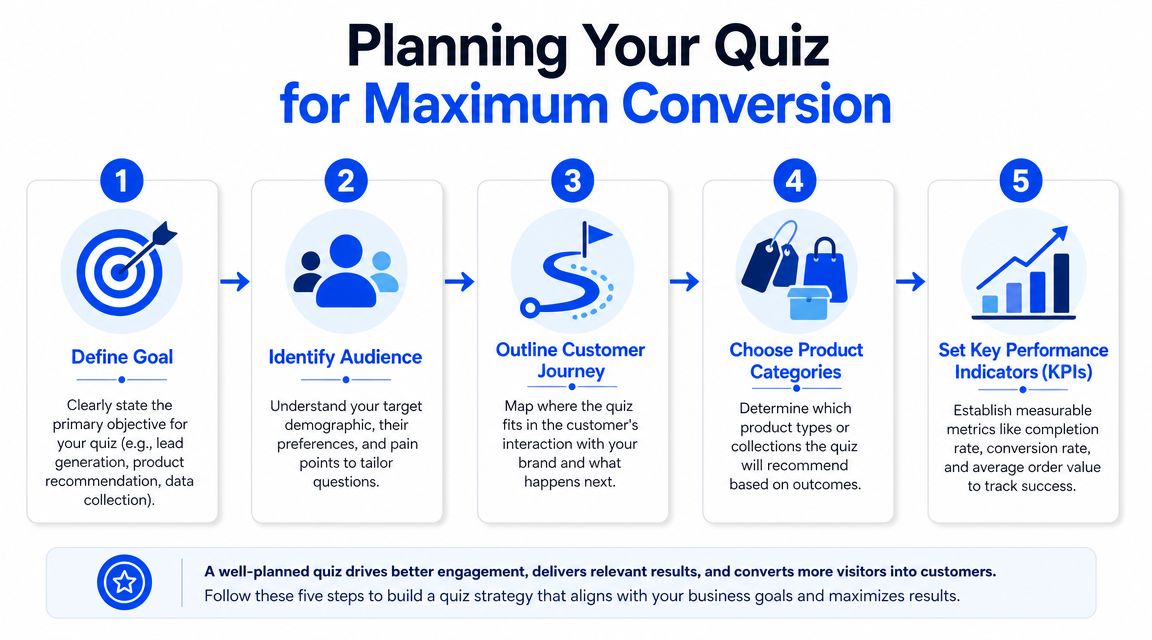
Start with one primary business goal
A perfume quiz can do several jobs, but it shouldn't try to do all of them equally at once.
If your store has decent traffic and weak conversion, build the quiz around product recommendation and immediate purchase. If you're earlier in the funnel and need audience intelligence, optimize for lead capture and segmentation. If the catalog is broad and your team still doesn't know how shoppers describe your assortment, focus on preference data collection.
Those choices affect everything that follows:
| Primary goal | Best result format | Biggest mistake |
|---|---|---|
| Direct sales | Product match with add-to-cart path | Ending on a generic “you're floral” profile |
| Lead capture | Results locked behind email or followed by opt-in | Asking for email too early |
| Data collection | Detailed scent profile plus stored attributes | Collecting answers with no plan to use them |
A confused objective creates a confused quiz. If the end goal is revenue, the result page can't behave like a personality test.
Build around the user's buying context
Perfume quizzes often fail because they assume every customer is buying for themselves. That isn't how fragrance shopping works. A meaningful portion of quiz traffic comes from people buying for someone else, replacing a past favorite, or trying to find a safe first purchase.
The difference matters because the logic changes.
Use planning questions like these before you write copy:
Self-purchase or gift
Self-buyers can answer mood and style questions. Gift buyers usually need safer guardrails and broader recommendation logic.New to fragrance or experienced
Beginners respond better to simple sensory language. Experienced shoppers may recognize scent families and note patterns.Daily wear or special occasion
The result set should reflect intended use, not just taste.
Gift buyers need decision support, not identity theater. If your quiz only asks whether the recipient is “bold” or “romantic,” you'll miss the practical concerns that drive gifting decisions.
Decide what the result page should do
Too much time is spent on the question flow and not enough on the endpoint. The endpoint is where conversion either happens or slips away.
Your result page usually works best in one of these formats:
Single best-match recommendation
Best when your assortment is focused and your logic is strong.Curated set of two or three products
Better when scent preference is nuanced and you want to preserve choice without overwhelming the shopper.Profile-first result with product options underneath
Useful when education matters and the buyer needs context before deciding.
The trade-off is clarity versus flexibility. A single recommendation feels decisive but can backfire if confidence is low. A small curated set often performs better because it gives the customer a sense of agency while still constraining the catalog.
Don't forget operational constraints either. If your hero products go out of stock often, don't build a logic tree that relies too heavily on a narrow subset of SKUs. Planning has to include inventory realities, bundling opportunities, and whether discovery sets should appear in certain outcomes.
A strong perfume recommendation quiz starts as a commercial blueprint. The copy, visuals, and logic only work when that foundation is clear.
Designing a Compelling and Brief Question Flow
The fastest way to ruin completion rate is to make the quiz feel like homework. Fragrance buyers want help, not an interrogation. Strong question flow feels light, visual, and intuitive.
That's why brevity matters so much in this category. Leading fragrance brands have converged on short quiz formats. Snif says its perfume quiz uses three questions to help shoppers find a scent, and Gents describes its fragrance test as a 20-second experience in Snif's perfume quiz overview. That tells you what the market has already learned. You don't need exhaustive intake to guide someone toward a likely scent family.
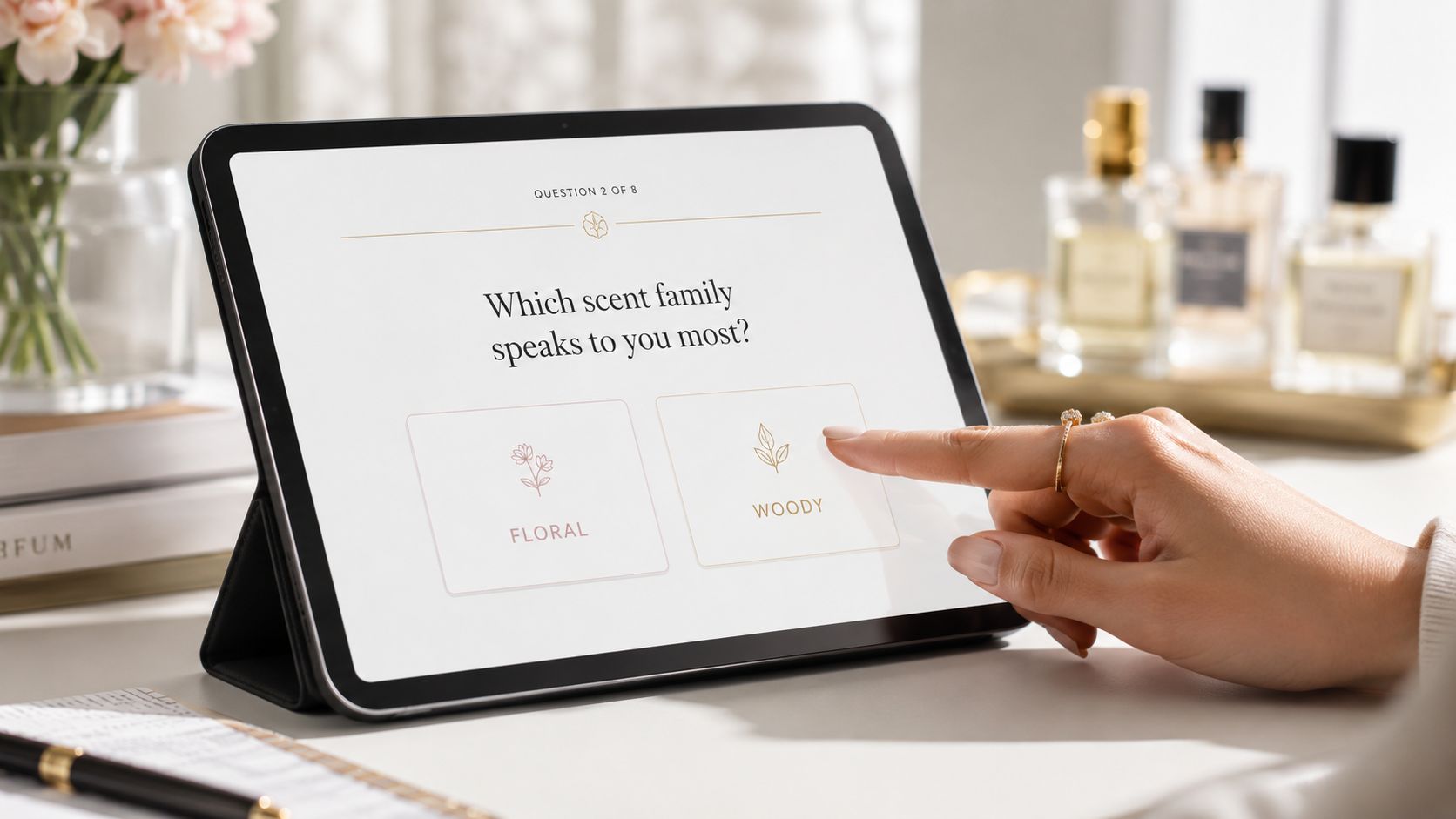
Ask broad first and specific later
The best-performing flows usually move from context to taste.
Start with the shopper's world. Ask about occasion, mood, or energy. Then narrow into preference signals like freshness, warmth, sweetness, or intensity. This order works because customers can answer lifestyle questions quickly, even if they don't know fragrance vocabulary.
Bad sequencing looks like this:
- “Which base notes do you prefer?”
- “Do you like vetiver?”
- “Choose your ideal sillage”
That language excludes casual buyers. It also creates fake precision. Individuals often cannot accurately answer technical questions if they haven't smelled the options side by side.
Use answer choices people can feel immediately
Image-led or mood-led responses usually outperform text-heavy note selection because they reduce interpretation effort. “Beach escape” versus “midnight dinner” is easier than “aquatic” versus “amber” for many shoppers.
Here's a simple example of a practical flow.
| Question Number | Question (Focus on Lifestyle/Mood) | Answer Options (Visual) | Maps to Scent Family |
|---|---|---|---|
| 1 | Where would you wear this most? | Office, date night, weekend getaway, evening out | Fresh, musky, tropical, amber |
| 2 | What atmosphere fits you best? | Clean and airy, cozy and warm, bold and dressed-up, playful and bright | Citrus, gourmand, musky, fruity |
| 3 | Pick a texture that matches your style | Crisp linen, cashmere knit, leather jacket, silk | Fresh, warm spicy, woody, floral |
| 4 | How noticeable should the scent feel? | Close to skin, balanced, statement-making | Soft musk, versatile floral, rich amber |
Keep the flow one question at a time
One-question-at-a-time design does two things well. It keeps the interface focused on mobile, and it makes the quiz feel shorter than it is. That matters because most abandonment happens when the screen looks dense.
A few practical rules help:
- Limit visible choices so the user can decide without scrolling.
- Use plain labels instead of perfume-industry jargon.
- Show progress carefully so the buyer knows the finish line is close.
- Write answers for speed because thumb-friendly selection beats typing every time.
A short quiz doesn't feel simplistic when the questions are doing real sorting work. It feels competent.
Cut questions that don't change the recommendation
This is the cleanest test I use when refining a flow: if a question doesn't materially alter the outcome, it doesn't belong in the quiz.
A lot of brands add decorative questions because they're fun. Fun is useful until it weakens the recommendation engine. Every question should either improve matching, improve merchandising, or improve segmentation. If it does none of those, cut it.
That discipline is what separates an engaging quiz from a profitable one. In fragrance, less usually performs better because the category already carries enough ambiguity. Your question flow should reduce it, not decorate it.
Building the Quiz and Mapping Product Logic
A perfume quiz becomes commercially useful only when the answers connect cleanly to real products. Often, builds fall apart on this requirement. The front end looks polished, but the result logic is loose, disconnected from inventory, or too abstract to support sales.
The build phase should focus on one outcome: turning preference signals into recommendations that are available, relevant, and easy to buy.
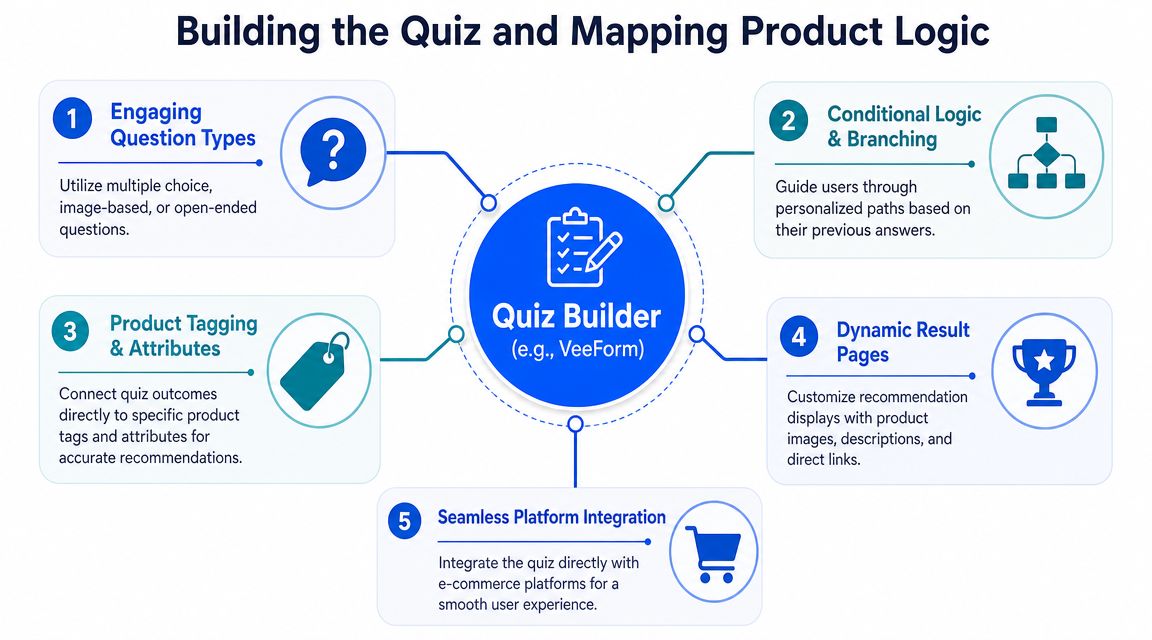
Choose between direct mapping and weighted scoring
Most perfume quiz logic fits into one of two models.
Direct mapping is the simpler option. If the shopper chooses a certain combination of answers, they get a specific product or a small predetermined set. This works well when your assortment is tight and your merchandising team already knows which products belong to each profile.
Example:
- Occasion = cozy night in
- Preference = warm and spicy
- Intensity = noticeable but not overpowering
That answer path could trigger a product tagged around amber, oriental, warm spicy, or gourmand in Shopify.
Weighted scoring is more flexible. Each answer adds points to one or more scent profiles, and the highest total determines the result. This model works better for larger catalogs because one answer can support several recommendation directions at once.
A simple way to think about it:
| Logic type | Best for | Risk |
|---|---|---|
| Direct mapping | Smaller catalogs, fewer hero products | Feels rigid if edge cases are common |
| Weighted scoring | Larger assortments, nuanced shopper intent | Gets messy if teams overbuild it |
Map to product attributes, not just vibes
“Bold,” “clean,” and “romantic” are useful front-end words. They are not enough for the recommendation engine on their own. Your product catalog needs structured attributes behind the scenes.
I usually want every perfume in the logic set to have internal tags or fields such as:
- Scent family
- Occasion fit
- Perceived intensity
- Seasonal lean
- Gift-safe or self-purchase lean
- Hero status or margin priority
Once those attributes exist, the quiz becomes easier to manage. You can rotate products in and out without rebuilding the full experience. You can also suppress low-stock items or prioritize discovery sets for uncertain buyers.
If your team needs a faster way to prototype quiz structure before wiring everything manually, an AI form generator workflow can help shape question paths and answer formats before you finalize the merchandising rules.
The right answer logic isn't “What product sounds good?” It's “What product should this exact buyer see right now, given what we know and what's in stock?”
Sync the result page to live commerce data
The result page should not feel like a dead-end recommendation card. It should feel like a shoppable continuation of the quiz.
That means the result should display:
- Real product names
- Current product imagery
- Actual prices
- Clear call to action
- Add-to-cart or direct product path
Recommendation confidence fades quickly if the result page feels detached from the store. Buyers should move from “that sounds like me” to “I can buy this now” without friction.
Build for maintenance, not just launch
A perfume recommendation quiz isn't a one-time asset. Your catalog changes. Seasonal products rotate. New scents arrive. Merchandising priorities shift.
Set the logic up so your team can manage it without a developer every time something changes. That usually means:
- Keeping answer sets stable unless data shows a problem.
- Using product tags or collections to control eligibility.
- Reviewing result mixes when inventory or hero priorities change.
- Auditing edge cases where too many shoppers land in the same bucket.
Teams often overcomplicate the first version. Don't. Start with a small set of high-confidence recommendation routes tied to your strongest products. Once the data comes in, then expand.
Good quiz logic isn't the most elaborate logic. It's the logic your team can trust, explain, and improve.
Launching and Promoting Your Perfume Quiz
A strong quiz can still underperform if shoppers never see it. Launch strategy matters because perfume discovery is often a motivation problem before it's a UX problem. Buyers don't arrive thinking, “I hope this store has a quiz.” They respond when the prompt matches their uncertainty.
That's why placement and promotion should frame the quiz as a shortcut to choosing, not as an extra task.
Put it where indecision happens
The homepage is the obvious placement, but it shouldn't be the only one. Some of the best quiz entry points are closer to the moments where confusion appears.
Good launch placements include:
- Hero banner entry point for new visitors who need orientation
- Main navigation link so discovery is always accessible
- Collection page prompt for shoppers browsing but not filtering well
- Exit-intent trigger for visitors who looked around and stalled
- PDP assist link for buyers comparing similar scents
The message matters as much as the location. “Find your signature scent” appeals to identity. “Get matched in a few quick steps” appeals to convenience. “Not sure where to start?” often works well because it names the actual problem.
Use channel-specific framing off-site
Paid social, email, and organic social shouldn't all use the same creative angle. A perfume recommendation quiz works best when the traffic source and the quiz promise line up.
For social ads, lead with discovery. For email, use the quiz to re-engage past browsers or customers who haven't found their next scent. For organic content, tie the quiz into education around fragrance families, gift decisions, or seasonal wear.
If your team is building a broader content engine around short-form promotion and campaign distribution, this guide for dominating social media is a solid practical reference for sharpening message hooks and channel execution.
A simple A and B launch matrix works best
You don't need a complicated testing framework to start. You do need disciplined comparisons.
Test variables like these:
| What to test | Version A | Version B |
|---|---|---|
| Headline | Find Your Scent | Take the Quick Scent Quiz |
| CTA button | Get My Match | Start the Quiz |
| Placement | Homepage hero | Collection page banner |
| Capture timing | Before results | After results |
The point isn't to test everything at once. It's to find out which message gets more qualified starts and which placement drives better downstream purchase behavior.
For email capture after the quiz, a simple lead capture form template can help teams think through what information to collect without interrupting the recommendation flow too early.
Don't launch the quiz as a feature announcement. Launch it as a shopping shortcut.
That framing changes everything. A feature sounds optional. A shortcut sounds useful.
Measuring Success and Optimizing for Revenue
If you can't tie the quiz to money, you don't have a revenue engine. You have an interactive asset. The difference comes down to measurement discipline.
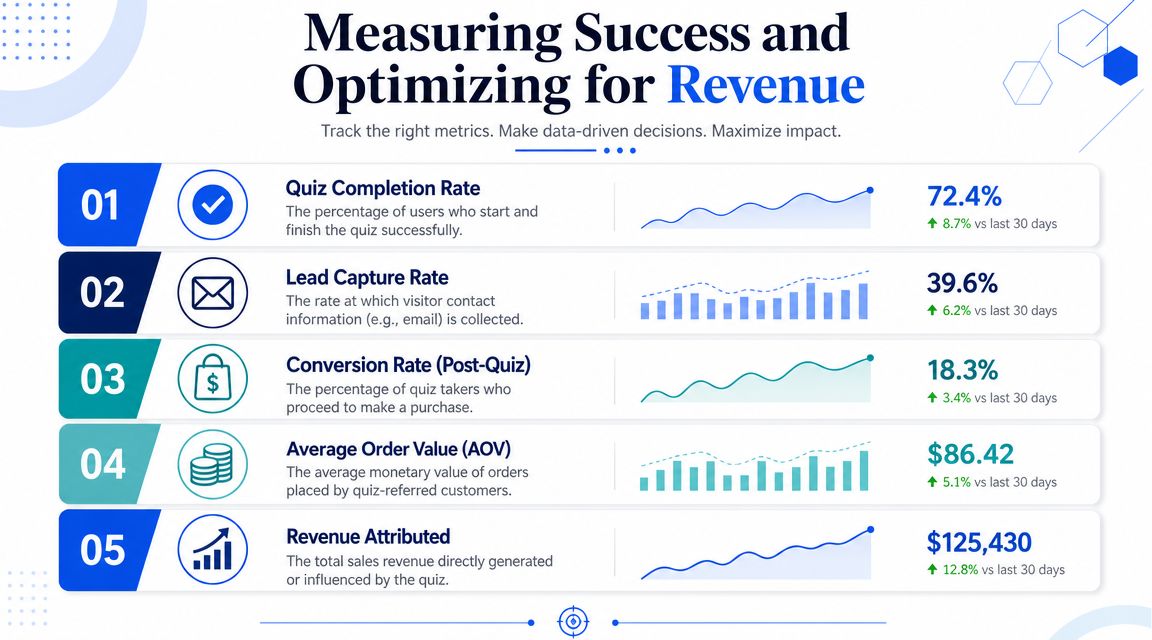
A good perfume recommendation quiz should be evaluated like any other commercial funnel. Where do users enter, where do they drop, what products get recommended, and which paths produce orders?
Track the metrics that explain business impact
Your dashboard doesn't need to be huge. It needs to be useful.
I'd watch these first:
- Quiz completion rate to spot friction in the flow
- Lead capture rate if email collection is part of the funnel
- Post-quiz conversion rate to judge recommendation quality
- Average order value to see whether quiz users buy differently
- Revenue attributed to quiz sessions to justify continued investment
Those metrics tell different stories. A high start rate with low completion usually means the flow is too long or unclear. Good completion with weak conversion often points to poor product mapping or a weak result page. Strong conversion with low starts usually means the quiz needs better promotion.
Measure result quality, not just quiz engagement
A common mistake is celebrating starts and finishes while ignoring whether the outputs are commercially sound. You need to know which result types sell.
Review questions such as:
- Which answer paths create the most orders?
- Which result pages get clicks but no purchases?
- Are too many users being pushed into the same scent family?
- Do gift-oriented paths convert differently from self-purchase paths?
Optimization gets practical. Sometimes the question flow is fine and the issue is that one recommendation set is too narrow, too expensive, or too risky for first-time buyers.
Tie the quiz back to paid efficiency and retention
When the quiz is catalog-synced, uses a one-question-at-a-time flow, maps to real SKUs, shows actual prices and images, and lets shoppers add to cart from the result screen, it can affect paid performance in a measurable way. One published fragrance funnel associated that setup with a 22% ROAS increase in this perfume quiz case study.
That doesn't mean every store gets the same result. It does show why quiz design should be judged by downstream efficiency, not only by on-page engagement.
The most valuable quiz data often shows up after the first purchase. Once you know who leans fresh, musky, tropical, or warm, your email and retargeting become much sharper.
That's where the second layer of ROI often appears. Preference data can shape replenishment campaigns, discovery set follow-ups, gift messaging, and new-launch segmentation. The quiz earns its place when it improves both immediate conversion and what your team can do next.
If you want to build a perfume recommendation flow without heavy development work, VeeForm gives Shopify teams a no-code way to launch one-question-at-a-time quizzes, collect preference data, and connect results to the rest of the customer journey. It's a practical option when you need to move from idea to live test quickly.
