A shopper lands on your Shopify store, opens a product page, scrolls a little, and sees a row of items under “You might also like.” Sometimes that works. Often it doesn't. The customer still has to figure out what's right for them, compare similar options, and translate your catalog structure into their own need.
That gap is where most product recommendation Shopify setups fall short. They surface products after the shopper has already done the hard part alone.
For stores with complex assortments, guided selling beats passive merchandising. A quiz can ask the same questions a strong retail associate would ask in-store, then route shoppers toward products that fit their use case, taste, constraints, or concerns before they bounce, stall, or buy the wrong item.
Table of Contents
- Beyond You Might Also Like Why Guided Selling Wins
- How to Design a Product Recommendation Quiz
- The Art of the Ask Using Question Types and Logic
- How to Deploy Your Quiz on Your Shopify Store
- Recommendation Quiz Examples for Perfume Apparel and Pet Food
- Measuring Success and Syncing Customer Data
Beyond You Might Also Like Why Guided Selling Wins
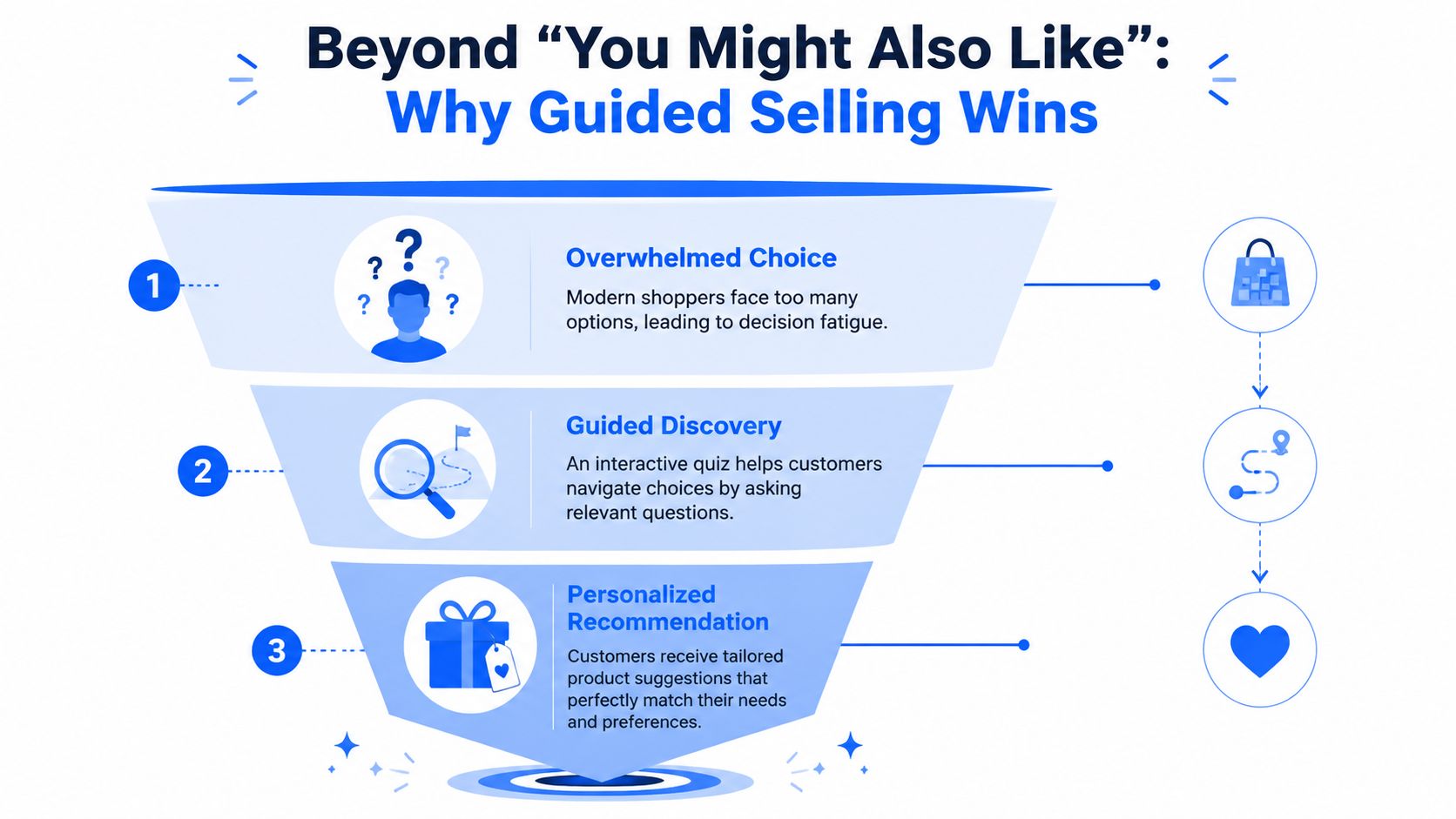
Most recommendation widgets are passive. They wait for the shopper to understand the catalog, know what they want, and click into the right place first. That's fine for simple products. It breaks down when the store sells nuanced choices like fragrance, fit-sensitive apparel, supplements, or pet nutrition.
A guided quiz changes the sequence. Instead of showing products and hoping the shopper self-sorts, it captures intent first. That's the difference between merchandising and guided selling.
Independent ecommerce research reports that only 7% of shoppers click a product recommendation, yet those clickers account for 26% of ecommerce revenue and 24% of orders, according to Clerk.io's product recommendation statistics. The practical takeaway isn't that every widget is working. It's that recommendation surfaces influence a small but highly valuable slice of traffic.
Why quizzes outperform static suggestion blocks
A basic “related products” row mostly answers one question: what else is nearby in the catalog? A quiz answers the more important question: what should this person buy right now?
That matters because shoppers don't think in collections, tags, or product families. They think in problems.
- Unclear fit: “Which version works for my skin, body type, or routine?”
- Too many options: “What's the difference between these products?”
- Fear of a bad choice: “I don't want to waste money on the wrong one.”
- Need for reassurance: “Show me the option that matches how I'll use it.”
Practical rule: If a customer would ask a store associate for help in person, you should consider replacing or supporting your widget with a quiz.
Quizzes also create a better emotional experience. A strong flow feels like a consultation, not a filter. That lowers friction because the shopper is making one small decision at a time instead of parsing a crowded collection page.
Where AI fits and where it doesn't
AI-based product suggestions can help after you've established context, especially for substitute items, cross-sells, and dynamic fallback logic. If you want a broader view of that layer, learn about Shopify recommendations with AI.
But AI doesn't remove the need to collect intent. If your customer is choosing a scent family, a fit profile, or a diet-sensitive formula, the store still needs explicit inputs. In practice, the stores that convert well usually combine both. They ask for intent first, then use recommendation logic to decide which products to show.
How to Design a Product Recommendation Quiz
Most weak quizzes fail before the first question is written. The problem isn't design. It's strategy. The store tries to build a quiz that does everything, for everyone, across the full catalog.
A quiz should help the shopper make one buying decision cleanly.
Start with one buying decision
The best quiz titles sound like promises, not tools. “Find your signature scent.” “Find your fit.” “Choose the right food for your dog.” Those are stronger than “Take our product quiz” because they clarify the outcome.
Keep the scope narrow enough that the recommendation feels decisive. If the quiz tries to choose skincare, routine order, ingredient education, and bundle logic all at once, completion drops and the result gets muddy.
Three strong starting formats:
Single-product selection
Best when one hero product solves the main problem. Good for fragrance, mattress types, supplements, and foundation shades.Routine or bundle builder
Useful when the right answer is a coordinated set. Think cleanser plus moisturizer, or shirt plus fit variant plus care add-on.Collection narrowing
Strong for large catalogs where the first job is reducing choice, not naming one winner.
Map answers to catalog logic
Once the buying decision is clear, map each answer to something operational in Shopify. That usually means tags, collections, product types, metafields, or a controlled SKU list.
If your product data is messy, the quiz won't save you. It will expose the mess.
That's why it helps to review your catalog structure before building logic. This guide on optimizing product attributes on Shopify is useful if your tags and metafields aren't consistent enough for recommendation logic yet.
A practical mapping sheet should include:
- Question and answer option: The shopper-facing language.
- Catalog signal: Tag, metafield value, product type, or collection rule.
- Outcome behavior: Include, exclude, boost, or branch.
- Fallback rule: What to show if nothing matches perfectly.
Don't write quiz copy from the merchant's point of view. Write it from the customer's decision point. “Need all-day wear” is better than “Long longevity preference.”
Keep the flow conversational
Ask one thing at a time. Start broad, then narrow. Early questions should segment the shopper into a useful lane. Later questions should refine the recommendation, not reopen the whole decision.
A solid flow usually looks like this:
- Open with use case: Occasion, primary need, category, recipient, or problem.
- Add one or two preference questions: Style, intensity, fit, texture, diet, sensitivity.
- Handle blockers: Allergies, exclusions, budget band, compatibility, age range.
- Collect lead data near the result or after it: Email capture works better when the value exchange is obvious.
If you want a faster way to prototype this structure, an AI form generator for guided quizzes can help draft the initial flow. The important part is still the logic map behind it.
The Art of the Ask Using Question Types and Logic
Question quality decides whether a quiz feels useful or tedious. Often, many Shopify merchants overcomplicate things. They ask too many open-ended questions, use the same format for every step, or ignore conditional logic and force every shopper through the same path.
Good quizzes feel shorter than they are because each question earns its place.
Match the question type to the decision
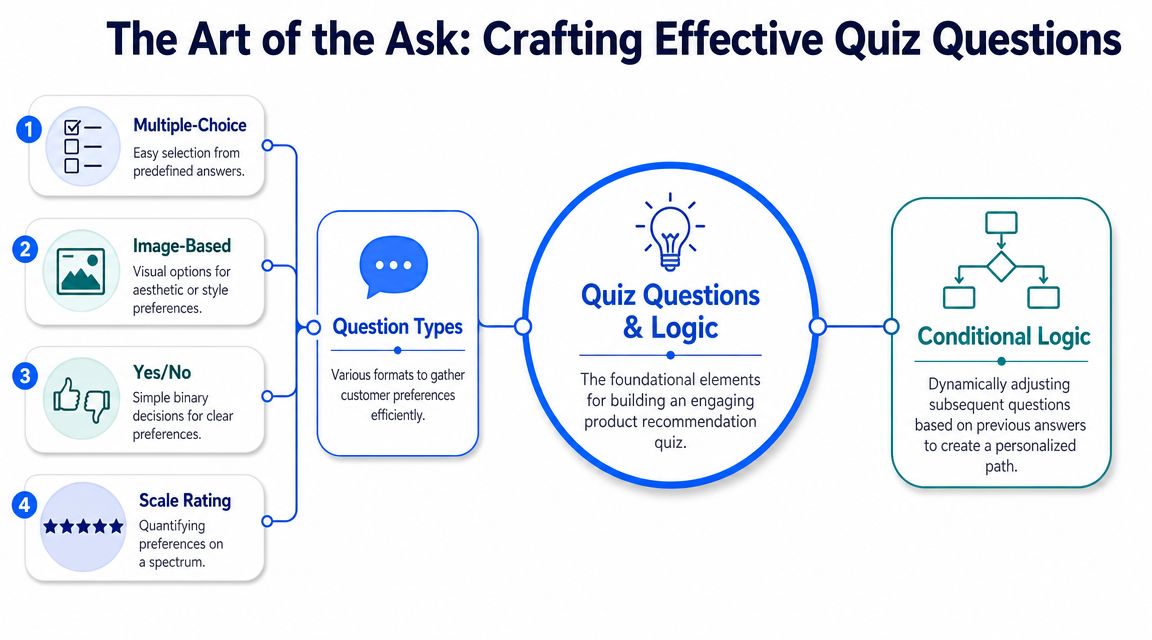
Different inputs do different jobs. Use the format that gets the cleanest signal with the least friction.
| Question Type | Best For | Example |
|---|---|---|
| Multiple-choice | Clear category splits | “Which scent profile do you usually prefer?” |
| Image-based | Style, aesthetic, or visual taste | “Pick the outfit silhouette you wear most” |
| Yes/No | Fast qualification | “Does your dog have grain sensitivities?” |
| Scale rating | Strength or intensity preferences | “How bold do you want the fragrance to feel?” |
| Dropdown | Long but structured lists | “Select your dog's life stage” |
| Short text | Rare edge cases only | “Anything we should avoid?” |
Multiple-choice usually carries the load. It's fast, easy to score, and clean for branching. Image-based answers work well when language gets fuzzy, especially in fashion and home products. Scale questions are useful when the recommendation should move along a spectrum, not jump between fixed bins.
Use logic to remove bad matches early
Logic isn't there to make the quiz feel clever. It's there to make the output trustworthy.
A major operational challenge is preventing bad recommendations. Shopify's system has eligibility rules, so recommended items must be available, priced above zero, published to the online store, and not already in the cart, as described in Shopify implementation guidance summarized from this operational walkthrough. A quiz with conditional logic helps because it can screen for suitability before the recommendation appears.
That matters in practice when a catalog includes edge cases:
- Inventory-sensitive items: Don't route users into products that frequently go unavailable.
- Restricted items: Exclude gift cards, samples, or placeholder products from recommendation pools.
- Need-based exclusions: Skip formulas, materials, or ingredients that conflict with the shopper's answers.
- Cart-aware paths: If they already have the core item, shift the recommendation toward add-ons or accessories.
Your result page should feel inevitable. By the time the customer sees it, the wrong products should already be impossible.
Conditional logic also shortens the experience. If a customer says they want a lightweight summer fragrance, they don't need to answer questions meant for rich evening scents. If they choose a slim fit, you can skip questions that only matter for oversized styles.
One practical build pattern is to use broad pathing first, then score within the branch. That keeps the quiz understandable for your team and easier to maintain when products change.
How to Deploy Your Quiz on Your Shopify Store
A strong quiz buried in the footer won't do much. Placement shapes performance as much as logic does. The right deployment depends on when customers need help, not just where you can technically embed a form.
Choose placements based on intent
The highest-performing placements usually match moments of uncertainty.
A few reliable options:
- Navigation link: Add a clear CTA like “Find Your Match” or “Take the Quiz” in the main menu when product discovery is central to the brand.
- Collection page embed: Useful when shoppers are browsing but haven't narrowed the catalog enough to buy.
- Product page CTA: Works when customers need reassurance before selecting a variant or comparing alternatives.
- Popup or slide-in: Best used as a recovery tool when behavior suggests hesitation.
- Landing page from ads or email: Strong when campaigns target a specific need and the quiz can continue that message.
For stores with content-driven acquisition, pairing quizzes with stronger landing-page structure also supports organic visibility. If you're tightening discovery pages and category architecture, this guide to expert Shopify SEO strategies is a useful complement.
Use native blocks where they fit and quizzes where they scale
Shopify's native framework distinguishes between related and complementary recommendations, and merchants can configure up to 10 related and 10 complementary products per item through the recommendation setup described in Shopify's merchandising documentation. That's useful on product pages, especially for straightforward cross-sells.
But it's still product-page-based logic. It doesn't give you a sitewide guided flow that can start from the homepage, a collection page, a campaign landing page, or a popup.
Here's where a quiz builder changes the operating model:
- Broader entry points: The experience can live almost anywhere on the site.
- Catalog-wide recommendations: Logic can pull from more than one product page's manually curated set.
- Better pre-purchase guidance: The customer gets help before they hit decision fatigue.
- Richer inputs: You can use preferences, constraints, and use cases, not just page context.
One option merchants use for this is VeeForm for ecommerce quizzes and forms, which supports embedded and popup-style flows.
A product walkthrough helps when you're deciding between embed, CTA-triggered modal, or onsite campaign placement:
Put the quiz where confusion happens, not where there's spare space in the layout.
Recommendation Quiz Examples for Perfume Apparel and Pet Food
Generic quizzes produce generic recommendations. Nuanced categories need category-specific questions. That's where many product recommendation Shopify articles stay shallow. They mention quizzes as an idea, but stop before the logic gets useful.
Independent guidance points to a clear gap here: most content doesn't explain how to build recommendation flows for purchases like perfume by scent family, apparel by fit concerns, or pet food by dietary needs, as noted in Wisepops' Shopify recommendation guide.
Perfume
Perfume shoppers rarely browse by product title alone. They buy through identity, occasion, memory, and tolerance.
A useful perfume quiz might start with occasion. Daily wear, date night, office, gifting. Then it can narrow by scent family, projection preference, and whether the shopper wants something fresh, warm, powdery, woody, or sweet.
What works well in this category is translating emotional language into catalog rules. If someone says “clean and understated,” don't return the brand's most complex niche scent just because it shares a note. Match the mood.
Good question angles include:
- Scent family preference: Citrus, floral, amber, woody, musk.
- Occasion: Daytime, evening, travel, gifting.
- Intensity: Skin scent, balanced, statement-making.
- Weather or season: Fresh for heat, richer for cold.
- Similarity anchor: “Do you want something close to what you already wear, or something different?”
Apparel
Apparel quizzes fail when they focus only on style words. Fit anxiety is usually the actual blocker.
A better flow starts with use case. Workwear, gym, occasionwear, daily basics. Then move into body-fit concerns and silhouette preference. Slim, relaxed, cropped, high-rise, room in the shoulders, more length, more structure.
Image answers help because customers often recognize a shape faster than they describe it.
A strong apparel quiz also handles practical constraints that collection filters don't surface cleanly:
- fabric feel
- stretch preference
- weather
- layering needs
- modesty or coverage preferences
- care expectations
If your store sells multiple cuts of the same core item, the quiz should explain why one fit is being recommended. That explanation often closes the sale.
Pet food
Pet food is one of the clearest use cases for guided selling because the buyer is trying to solve for the pet's needs, not browse a lifestyle category.
A strong pet food flow usually begins with the pet profile. Dog or cat, life stage, size, activity level. Then it gets into sensitivities, goals, and feeding constraints. Weight management, digestion, skin and coat, grain sensitivity, protein preference, picky eating.
This category benefits from logic that filters aggressively. The wrong recommendation doesn't just reduce conversion. It breaks trust.
The more consequential the purchase feels, the more your quiz should act like a specialist, not a filter menu.
The best result pages in pet food also explain the match in plain language. “Recommended because your dog is in a senior life stage and you selected digestive support” is much stronger than listing products without context.
Measuring Success and Syncing Customer Data
Many organizations stop at quiz completions. That's not enough. A quiz is only valuable if it improves merchandising decisions, conversion quality, and follow-up relevance.
Shopify's analytics already include reports such as Product recommendation conversions over time and Product recommendations with low engagement, documented in Shopify's behavior reports. Those are useful for theme-based recommendation blocks.
Measure behavior not just submissions
A dedicated quiz gives you another layer of detail. You can see what people asked for, where they dropped off, which answer paths produce purchases, and which outcomes lead to low engagement.
The most useful review rhythm is simple:
- Look at starts versus completions: If starts are healthy but completions are weak, the flow is too long or the opening questions are poorly framed.
- Review answer distribution: If one answer dominates, you may be asking a weak question or offering unclear choices.
- Check result engagement: If users finish but don't click through, the recommendation or result-page copy isn't persuasive enough.
- Compare paths, not just totals: Some branches attract lower-intent visitors. Others produce stronger orders.
A drop-off point is usually a diagnosis. It tells you where the quiz stopped feeling helpful.
Send answers into your CRM and email stack
Recommendation quizzes go beyond being a conversion widget. They generate zero-party data a customer gave you directly. Preferences, use case, sensitivity, fit concern, gift intent, life stage, and more.
That data belongs in your CRM or email platform, not trapped inside a form report.
Once synced, you can use it to:
- Segment follow-up emails: Send care guides, replenishment reminders, or education tied to the shopper's answers.
- Personalize campaigns: Feature products and content that match declared preferences.
- Enrich contact records: Give support and retention teams more context on what the customer was trying to solve.
- Build better retargeting angles: Lead with the problem they identified, not a generic best-seller message.
If you need a lightweight way to collect contact details before or after results, a lead capture form template for qualification flows can fit neatly into the process.
If you want to turn product discovery into a guided selling system, VeeForm can be used to build no-code recommendation quizzes, lead capture flows, and embedded Shopify forms that collect intent before showing products. It's a practical fit for stores that need more than a basic related-products widget.
